Our Journey as Producers of Fleckvieh Simmental Cattle.

Latest

New Addition at Applecross

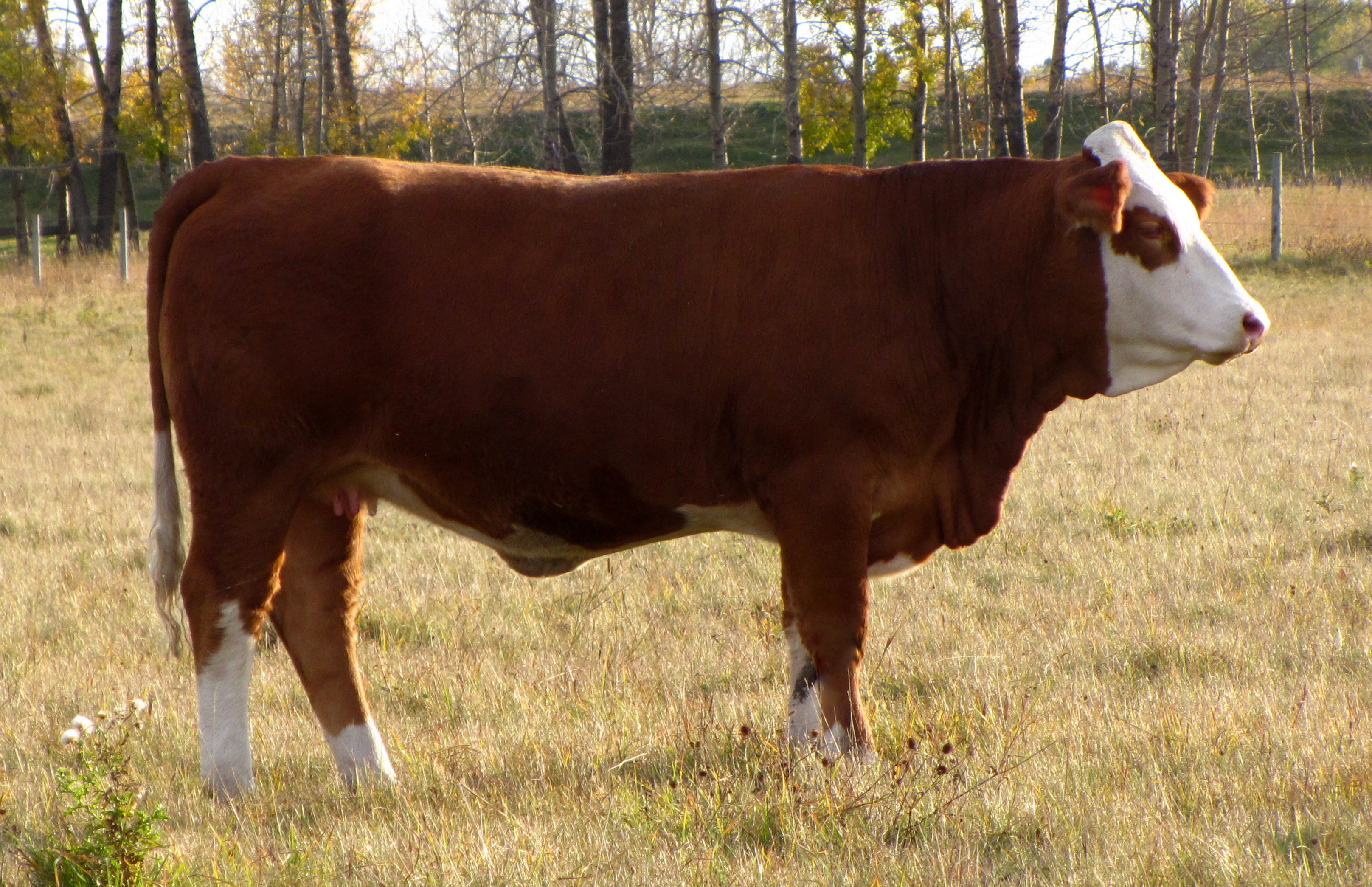
The Newest Edition to Our Female Lineup - Delta-Rho Miss Marnie

We have been successful in acquiring ‘Delta-Rho Miss Marnie’ at the recent Fleckvieh Forum Sale, held in conjunction with Bar 5’s Extravaganza on October 2nd.  We couldn’t make it to the event, but were very fortunate to have Dad there to look over Marnie for us.  It is great to be able to have ‘eyes’ in two places at once, when we can’t make it back to Ontario.

There are a lot of factors that drew us to Marnie, not the least of which was her sire, Well House Kestrel.    We are very familiar with this classic sire, as Mom & Dad have utilized him extensively.  Our favourite daughter of his was SRN Ms. Bestrel 7Y who walked the Dora Lee pastures in the 1990’s and produced some really impressive offspring.  The ‘classic division’ of our program in now
essentially complete.  With Marnie’s addition, we now have direct daughters of Well House Kestrel, King Arthur, Antonius and Sim-Roc C&B Western all walking our pastures.

We are, as mentioned, quite happy to have added a Kestrel daughter to our herd, but at the same time there are a lot of other factors (her feet and udder, bred to a calving bull and her temperament / halter breaking) that played into our decision to buy her. Quiet cattle are very important to us, as we really enjoy walking the cow herd without them being disturbed. The Rauscher’s at Delta Rho also had a DNA profile completed on Marnie, which we used as another ‘piece of the puzzle’. It is nice know that Marnie has the genetic potential to be very feed efficient, and will hopefully pass that trait on to her offspring.

Pictured here, fresh off the truck, Marnie fits in quite well with our bred heifer group, and we look forward to an exciting calf in January. We certainly know her service sire, Eclipse, well. We are confident Marnie will be an important part of our cow herd for many years to come.

Giving Thanks

As we pause to give thanks this week-end across Canada, it is a great opportunity to remind ourselves of how blessed we are.

We live in a country that, while not perfect, is among the best and safest countries on the planet.  We are blessed with an abundance of natural resources, clean air to breath, inexpensive food, and a roof over our heads.  Closer to home, we are thankful for another year of healthy cattle, abundant grass, and big calves.  We are thankful for a strong cattle market, and what appears to be a turning of the tide in the beef business.

And finally; most importantly, we are thankful for our friends and family.  They are our support network that helps ground us to reality when times are great, but are always there to pick us up when times are tough. Hopefully everyone gets the chance to have a visit or share a meal this week-end with people that are important to them.

Happy Thanksgiving!

Applecross @ The National Trust Bull Expo

We are pleased to announce that APLX Envoy 2Y will be our 2011 entry to Transcon’s National Trust Bull Expo on Friday, November 4th in Olds, Alberta.

Envoy is a tremendously long bull, and he showcases an incredible combination of volume and style.  Heavily pigmented and smooth polled,  Envoy was the ‘big boy’ of this year’s bull calf crop.  Envoy is out of our Lady Western cow and sired by Dora Lee’s Equinox, making him a full brother to APLX Ensign 2X, our Trust entry from last year.

We feel the Trust is a great opportunity to showcase Envoy, prior to him leading our bull group to the 2012 Red Deer Bull Sale in March.  We will post more information and pictures in the upcoming weeks.

Weaning Time

Applecross Janelle 7Y - pictured August 1, 2011

One of our Labour Day traditions here at Applecross is to wean calves.  We actually start the process a week earlier – when we put quiet-wean nose tags in all the calves, take the weaning weights and then turn them back out with their moms for one final week. We find the two-step process allows the calves to cure their milk addiction in week one, and then only have their separation anxiety to deal with once pulled on Labour day. Using the quiet wean nose tags seems to make for a quieter weaning, and the calves don’t seem to go back as much either.

The weaning weights are always exciting. I have a hard time judging weights in the field, and sometimes calves you think are close to the same size, can be almost 100 lbs apart when weighed. With the separate pastures for heifer and bull calves, I also find it difficult to relate between the two pastures – the big heifers don’t get to stand beside the bull bulls (which is definitely a good thing with the heifers starting to cycle!), but the drawback is not being able to get a good weight comparison. You always have a pretty good idea which calf is biggest in each particular pasture, but the size correlation always seem to be a mystery until that weight is taken.  Add to this the adjustments for March calves vs. their January counterparts, for their 200 day weight, and the final tally can be eye-opening.

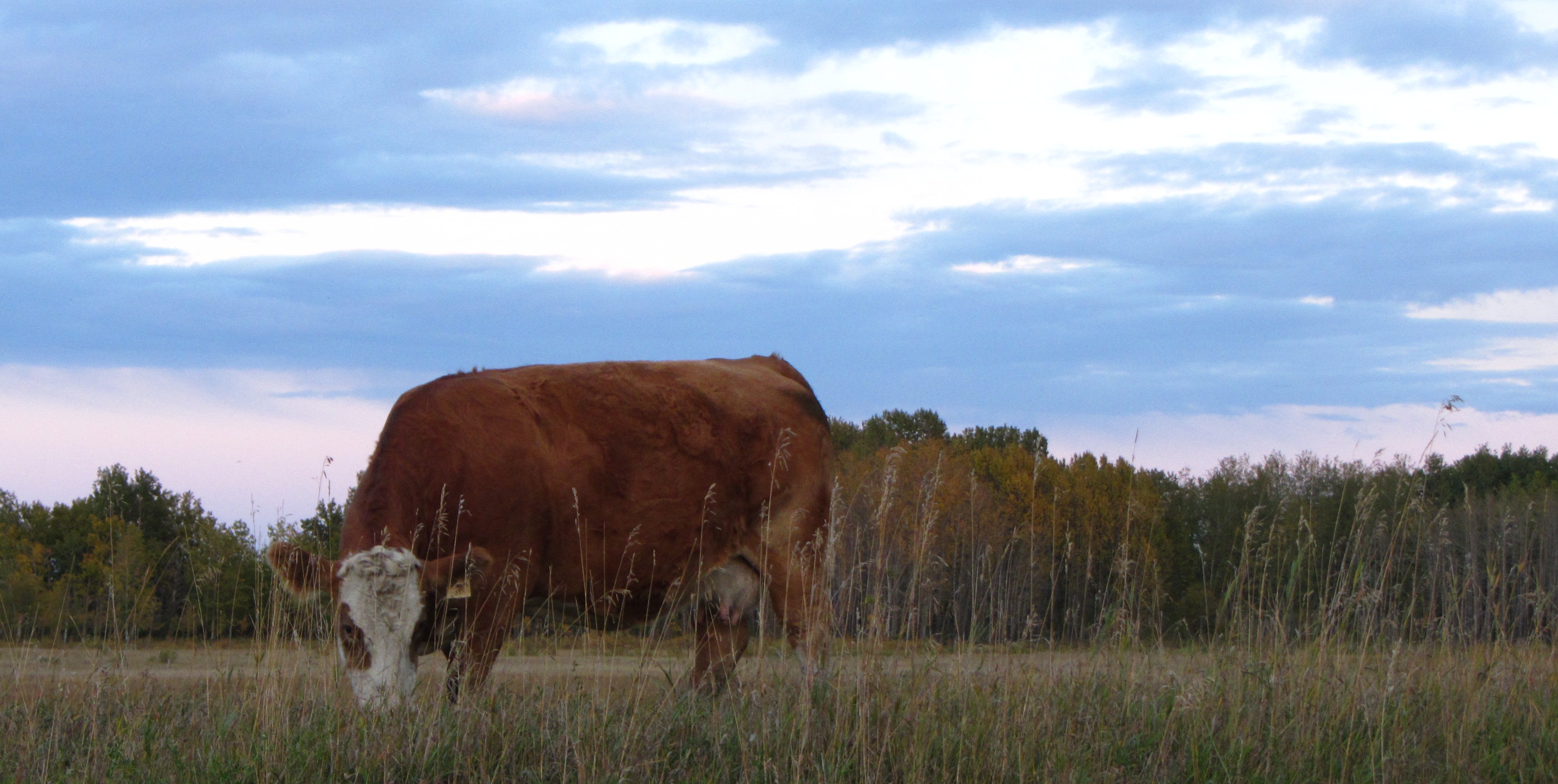
This year though, the heavyweights at weaning weren’t really a surprise. APLX Envoy 2Y has been the calf crop ‘big boy’ almost since birth, so it is not shocking he was the top calf. A Lady Western by Equinox son, Envoy is a full brother to APLX Ensign 2X from last year. He is exceptionally long, and has the power to develop into a polled performance bull, just like his brother. The top heifer was Applecross Janelle 7Y, an Anchor T Ikon by Jasmine, one of our Eclipse cows. As you can see from her August 1st picture, she has a lot of volume already, and we expect her to turn into a big capacity cow; just like her mama.

Of course, with weaning also comes decisions: Which calves make the grade? Which breds didn’t breed? Which cows came up open? What replacements should we keep back for our own use?

For the bulls that stay, development starts for the 2012 Red Deer Simmental Bull Sale next March, followed by some private treaty sale for a few March calves that we think still make the grade as herd bulls.

For our keeper heifers calves, the big decision on them gets deferred. We think the heifers form a really nice group, and would like to keep them all, but as we are nearing our size capacity, we feel we should potentially start to sell some.  At this point we are tentatively planning to market females in the fall 2012 sales season, but a lot can change in the next 12 months. In any event, we will have to start selling females some time, which will be an exciting next step for Applecross.

Regardless of whether it is a bull or heifer calf, it is great to get to start looking at them as individuals, and comparing them to their peer group.  Yes, it will still be a little noisy for a few days, but it is just another step in the breeding stock cycle, and soon enough the cows will be back focussing on grass, and the calves will start growing and developing on their own.

It is often also the perfect opportunity for us to update our cattle pictures as well.   We try to refresh our pictures at least once a year, especially the first and second calvers, whose appearance can change a tremendous amount over the course of a year, and (of course), not every cow co-operates when you are out trying to get good pictures.  There are always a number of cows that have a ‘good but not great’ picture, that just doesn’t do justice to how they look working the pasture  – thus we want to ensure our herdbook pictures are as accurate a reflection as possible as to what they look like.  September starts the clock ticking on the last window of opportunity to get that better picture before the udder dries up for another year.

Fortunately for us, we have been blessed with a gorgeous start to September, and nothing but clear skies and warm summer temperatures forecast for the next two weeks.  After trying summer conditions, it is good to get a spell of good weather; hopefully leading to a great head start on getting the fall work done, yet still leave plenty of time for walking the cattle (camera in hand), watching the latest batch of Applecross calves develop.

Dora Lee’s line-up for the 2011 Fleckvieh Forum Sale

My parents operation, Dora Lee Genetics, have set their line-up for the 2011 Fleckvieh Forum Sale, ‘Eastern Canada’s Premier Fleckvieh Showcase,’ to be held on October 2nd in conjunction with Bar 5’s annual female sale.  My parents are founding members of the Forum group, and for the past 18 years it has represented the only way to access Dora Lee Genetics by public auction.

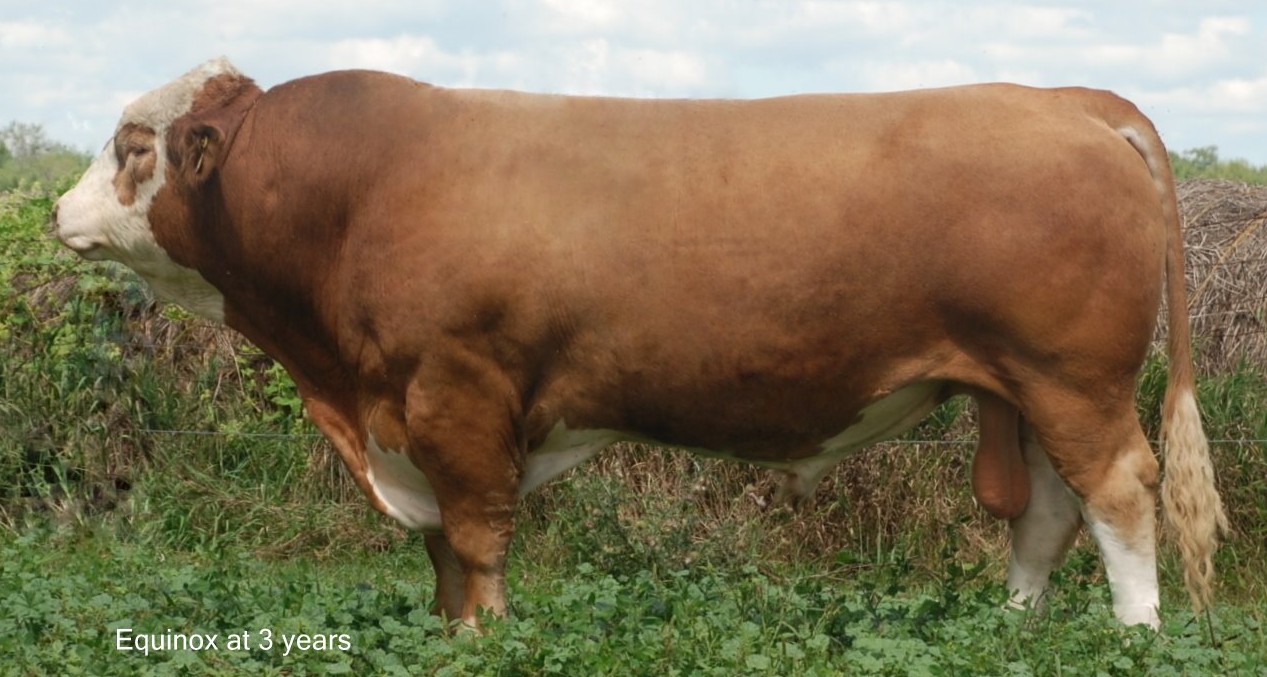
This years’ sale line-up is headlined by the introduction of Dora Lee’s Equinox, the exciting new homozygous polled herd sire that we have pictured above.  We had the opportunity to help prove Equinox over the past 2 years, and to say we are pleased is an understatement.   His first son to sell was our very own APLX Ensign 2X, which was the high-selling Fleckvieh bull at the 2011 Red Deer Simmental Bull Sale, so we are really looking forward to how his first daughters are received in Ontario this fall. Three daughters, along with 30 doses of semen will be on offer.

Not to be outdone by his son, Dora Lee Eclipse will again be well represented in the sire group.  Three daughters, and another semen lot, will also sell.  With the high demand for calving ease bulls, Eclipse seems to be one of the few that combines calving ease with maternal calving, so I think his impact will stand the test of time.

Dora Lee will be selling 7 bred heifers in total, plus the two semen lots.  Be sure to check out the catalogue; to be posted shortly on both the Bouchard Livestock and Bar 5 websites.

Stuff My Dad Says

Dora Lee Elexis: Dam of both Eclipse and our very own Evangeline. Now working at Anchor D Ranch, Dan & Karen Skeels, Rimbey AB

I think that everyone can relate to having their father, over the years, pass along words of wisdom to their children (witness the amazing success of the book and twitter feed of ‘Sh*t My Dad Says’).  In my case, having my dad involved in the cattle business for almost 40 years, he has not only advised us in the day to day journey of life, but has also provided a lot of advice and wisdom for both the farm and the genetics business. Despite living a few provinces apart, Dad still has a great impact on our farm.  I am fortunate to have just spent a few days visiting with him (and of course touring/talking cattle).  The time spent together is always wonderful, and brought to mind several of his customary sayings.  Three of my favourites are:  ‘Rome wasn’t built in a day’, ‘sometimes you have to make do without until you can afford to get what you want’ and ‘when breeding cattle, you have to look out 3-5 years and plan accordingly’.  There are other sayings of course, but these are three that continue to pop up in conversation, especially when we are talking cattle or about improvements we are constantly striving to make at Applecross.

The first phrase on Rome is both a cautionary tale and one of perseverance.  Don’t try to do everything at once – it is better to start and complete a few jobs/tasks at hand, then start a whole bunch, but have nothing complete.   The second part relates to the importance of perseverance – ‘keeping at it’ and constantly improving the farm operation, making small changes every year to make things better.  Rome wasn’t built in a day; it evolved over time by changing and adapting to the needs at the time, and as a result, was the pre-eminent western civilization for more than 1000 years.

With us in our formative years of Applecross, there are a lot of things we would like to have, but don’t.  Doing without, until we can afford to get want we want, is a constant mantra in our operation.  There are always things to spend money on – from improved handling facilities to a better stock trailer, more wind-breaks and purchasing improved/outcross genetics; there is, and will always be, a debate over where to spend our limited funds to the most benefit of our operation.  Doing without is also a comment on making do with what you have vs. spending money on a middle step, and then having to redo your plans yet again when you do have the funds.  Having a plan to ‘get what you want’ eventually is important, but in the interim, it is maybe better to do without and work with what you have, instead of rushing a project that you may not be happy with.

The 3-5 year plan is probably one of the most important lessons Dad has taught me about the genetics business.  As referenced in the previous post on patience, cattle take time to develop and prove their worth.   A great example of this is a major herd decision that became the evolution of Dora Lee.   I remember very clearly in 1999 when Dad, Mom and I debated the merits of introducing the polled gene to the Dora Lee herd – we wanted to see for ourselves if we could develop a polled bull that could stand with the best of the breed.  We started by utilizing one of our top proven cows (Dora Lee Fraline), and crossed her with one of the few polled Fleckvieh bulls at the time (Eisenherz) to get the ball rolling. We got very lucky.  That first pairing produced Electra in 2000, who in turn gave us a polled calf, Elexis, in 2002.  Our luck continued when Elexis gave us a polled Evangaline in 2004, followed by polled bull, Eclipse, in 2005.  With two generations of horned now in the pedigree, Dad thought Eclipse was the polled bull he was looking for to utilize extensively on his herd.  He was not disappointed.  Coloured right and calving easily,  Eclipse began to throw very appealing offspring that stood with the best horned genetics – exactly our goal from the start.  The pinnacle for Eclipse was the 2010 Fleckvieh Forum Sale – 8 daughters averaged $3,400 and were selected by breeders from 3 provinces.  Semen has sold across North America and to Europe.  11 years after that first decision to try and incorporate the polled gene, Dora Lee Eclipse was a proven success.

Looking back at this awesome example, it is no surprise that looking out a minimum of 3 to 5 years is important to the success of your operation.  In Eclipse’s case, it was an 11 year timeframe to achieve an objective. To create him, we took a horned female, added the polled gene and then two generations of horned genetics in just 6 years. The genetic probability of doing this was about 3% (and even just a fraction of this when you consider the other factors such as calving ease, colouring/pigmentation, and disposition that Eclipse also has). We then spent the next 5 years proving the bull – evaluating the offspring; first internally within our own respective herds, and then by offering genetics to the public.  We were incredibly, incredibly fortunate to develop and prove a new outcross polled bull within the timeframe that we did.

Most day to day decisions – what AI or herd bull to use, or what female to purchase – will have an impact a lot more quickly than in 10+ years, but I do believe that the 3-5 year timeframe is a minimum.   Today’s genetic decisions can become tomorrow’s building blocks at best, or an expensive step in the wrong direction at worst.   Doing some longer range planning (and having your eggs in more than one basket), can help prepare for the future.  That is why we try to ensure that, despite our limited numbers, we maintain and build some genetic diversity; whether through ongoing female purchases or the use of different AI sires.  We have some polled, some horned; some timeless genetics, some new.  We have a single long term vision of where Fleckvieh cattle need to get to, but feel we should explore different avenues of getting there.   And besides, breeding cattle is a journey without a final destination point – there will always be room to get better – so even 10, 20 years from now, there will still be that desire to improve cattle.

As we move forward with developing our own identity here at Applecross, it is great to be able to talk to Dad and tap his wisdom and opinions gained from being a lifelong Fleckvieh breeder.  It is a tremendous thing to be able to share in a passion such as Fleckvieh cattle with your parents.  Spending time together, touring and talking cattle, and getting those gentle reminders about staying patient and thinking out that 3-5 year plan, and keeping that plan fresh in your mind, is a wonderful way to spend a gorgeous August day.    Hopefully just one of many such days in the future!

The Virtue of Patience

I will be the first to admit that I am not a patient person.  It might not be totally my fault – I think to some extent society has changed.  Take sports for example – we have progressed from getting our box scores from the morning newspaper, to watching highlights at the top of the hour on the 24 hours cable sports channel, and now we get it on demand, as soon as it happens, on the internet.  When we used to vacation, we’d go to see Jeanne’s Grandpa in Nova Scotia – he of no TV, let alone internet.  The first 48 hours were a bit of a withdrawal – you couldn’t just get up and ‘check things out’ on the ‘net, you had to be patient and wait for the next mornings’ paper.  Once you were there for a few days, it became a lot easier, but those first few days were tough!    I hope the same trend follows for me in the cattle business – maybe after a few more years, I’ll  be more patient!

It is always so exciting to put together a genetic mating – the hard part is waiting to see how it turns out. It takes nine months from breeding to calving, then six months to weaning, and six months of development to a yearling.   And even then, as a yearling, genetics are just getting started.  For bulls, it is another year until you see their calf crop (and then a year after that to see how those calves develop).  For heifers, it can be even longer – it is said that a Fleckvieh cow doesn’t hit her stride until age 5 or 6!  That’s at least 7 years since she was conceived!  That is a long time to wait in a world where we want answers instantly.

The commercialization of DNA and genomics into the beef herd does have the potential to accelerate the process, but a lot of other factors such as feet, temperament and milking ability need time in order to be evaluated.  These can represent ‘checkpoints’ along the way to evaluate potential, and where animals rank within your own herd.  The bottom end cattle always need to be cleaned up, and replaced with something that has at least the potential to be better.  If we are doing our jobs right as cattle breeders, then a cow should produce a better offspring, so the herd should gradually improve.  The challenge, of course, is ensuring that the offspring are indeed better than the parents, an assessment that is not always that easy to make – at least in less than 7 years!

Needless to say, maybe I should have chosen a passion in life other than cattle – it is certainly a career totally at odds with today’s instant availability of information.  But maybe, just as importantly, cattle are a steady reminder that the best things in life take a little patience – as well as some effort; some attention to detail.  Accentuating the importance of taking a longer term approach in life as opposed to instant results.  Maybe purebred cattle are really just doing me a favour; re-emphasizing patience, in a world that has got seemingly so fast, so full, and reminding me to sit back and relax a little.   Maybe a little patience is not such a bad thing after-all.

The Great Halter-Break

Jeanne with 2010's APLX Ensign 2X

So, I married a city girl. Well, I guess not technically a city girl.  Jeanne grew up on 10 acres just south of Hamilton, on Ontario’s Niagara Peninsula.  There was just enough land for a cow, a couple of horses, and all the pets (dogs, cats, rabbits and a hamster) that a house full of three tom-girl daughters could handle.  With Jeanne’s and her family’s involvement in the military, her life revolved substantially around the armouries in Hamilton, and she always seemed quite at home navigating the one-way streets of the downtown core.  A ‘farm’ girl to her city friends, but a ‘city’ girl compared to where I was from, she has always been a unique blend of urban smarts with country calm.

Jeanne’s love of nature and the environment led her to the University of Guelph, where we met.  We studied topics about as diverse as you could get and still be ‘Aggies’ – Jeanne in Environmental Biology, and myself in Agricultural Business. They grouped all of the first year agriculture students in one big common ‘Agriculture’ course and, through luck of the draw, we ended up being in a lab group together.  One thing led to another and, somewhere between my volunteering to cook her breakfast if she would finish typing our final group report on a Saturday morning, and becoming couple-number-two on the class square-dance set, a partnership was formed that has now lasted almost 20 years.

When we started Applecross, Jeanne was convinced that a portion of her summer off from teaching school should be spent halter-breaking calves – the thought being that with both of us working full-time, there was more time in the summer to train cattle than immediately prior to the sale.  While Jeanne has been around Fleckvieh cattle since we met, she had never actively worked them. I was a 4-H’r all the way up (it was a 4-H interprovincial exchange to Alberta in 1991 that first piqued my interest in farming here some day), and had spent a lot of the summers of my teens preparing my 4-H heifer for our fall achievement days, and the fall shows.  Jeanne, however, had none of this experience, but she was quite keen to give it a go.  Armed with the assistance of our vacationing eight year old nephew (also a city boy), and a 16 year old neighbouring farm girl (who is a dance student of Jeanne’s), she started the task in August of 2010 to spend three weeks prepping bull calves.

Last summer, the primary focus was APLX Ensign 2X. We thought he was a really good calf, and we were hoping to display him at Transcon’s National Trust Bull Expo.  This was our first public display so we wanted to do a really good job with him, as we have always thought that first impressions mean a lot – not only for Ensign, but also for Applecross and establishing our reputation as a breeder. While Jeanne worked with all the bulls, Ensign did receive some extra attention – he was the one that would be showcased in two months, and we wanted him to be ready.

Needless to say, we were quite pleased with how things turned out, both in compliments and observations at the event itself, and in how Ensign eventually sold in March’s Red Deer bull sale. Pam Langer first saw Ensign at the Trust, so it was easy to relate their March purchase back to his original display last October. While we know there won’t always be this definitive link between the two; it was great to experience a direct correlation between our original promotional/marketing efforts and the final results. We definitely plan on displaying at the National Trust Bull Expo again in 2011.

Now summer once more, Jeanne has enthusiastically decided to halter-break calves again. She is starting earlier (July vs. August), so that the calves will be 100lbs lighter and thus a little easier to (wo)man-handle. She will have her trusty assistants available to help at least some of the time, and we look forward to continuing our efforts to turn our now nine year old nephew into a farm boy.  Jeanne has even decided to learn how to clip this summer (thanks to some encouragement from ‘Becca Beechinor), in order to complete the full fitting experience for future sales events. Not that  I am concerned, but I figure that, worst-case scenario, by practicing in the summer at least the hair will grow back prior to the bulls needing to be showcased. We might have some funny looking cattle in the pasture for a few weeks, but there is only one way to learn (4-H’s ‘learn to do by doing’ motto sure stands the test of time). And hey, it has been almost 20 years since I clipped in 4-H, so it is not like I am a seasoned expert, either.

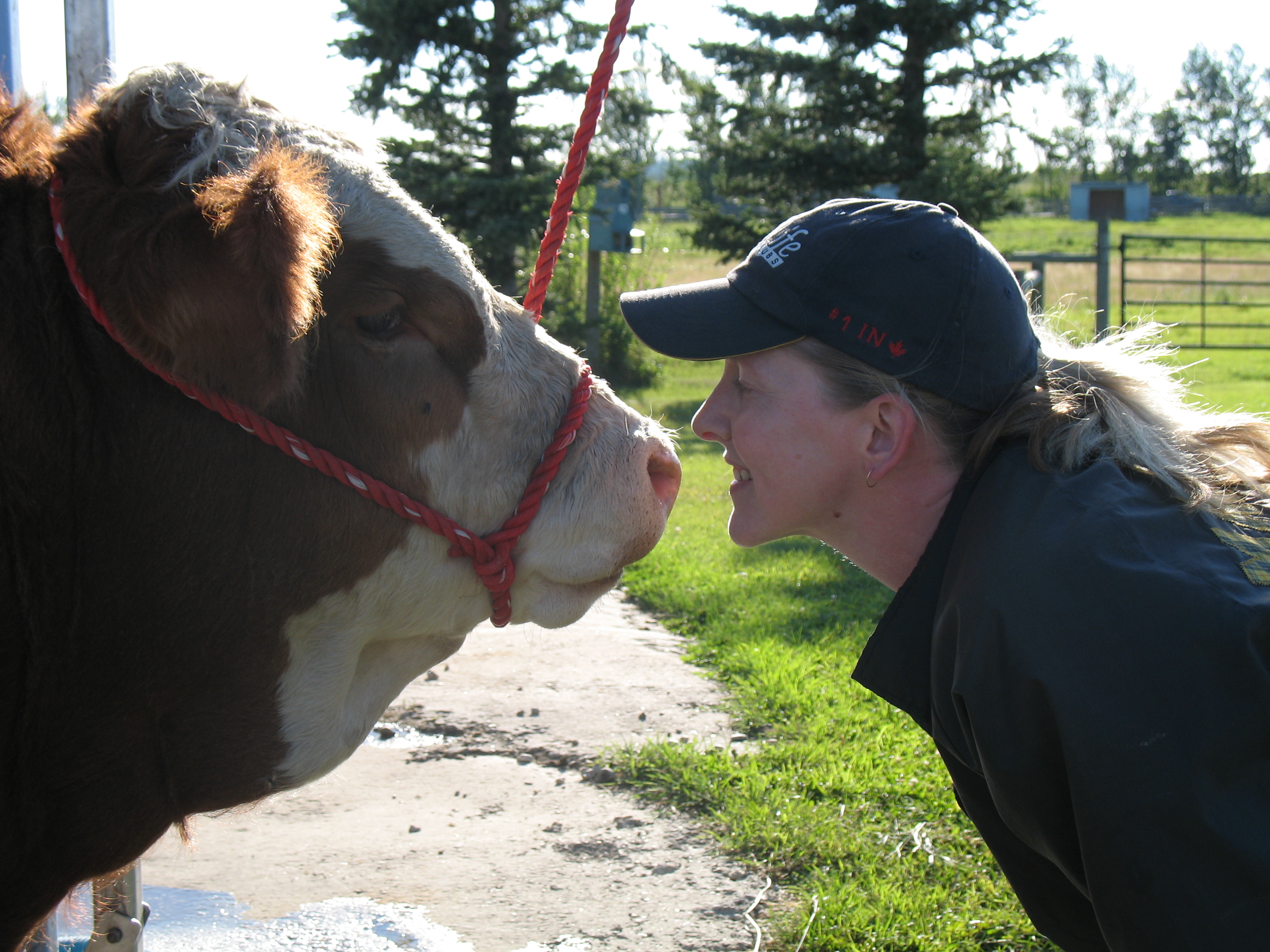
So, as we start on season two of the great halter break today, I thought it fitting to talk a bit about Jeanne and her efforts that go on behind the scenes; getting cattle ready.  Applecross is a partnership in the truest sense of the word, and while we both have specific roles that we work best in, together we are definitely more than just the sum of our parts. Here is to Jeanne – nose to nose with an opportunity and desire to learn a new skill, taking that plunge, and then coming back for more in year two.  It is always wonderful and astounding that she wants to be actively and enthusiastically involved in this crazy passion of mine called Fleckvieh cattle.
Genomics and DNA – Yes We Test

Every year, about the 2nd week-end in June, we vaccinate the cow herd.  The timing usually matches two weeks since they were put to grass, which allows them to ‘get a little more solid’ when working behind them.  For the last two years, we have also taken the opportunity to collect DNA hair samples for genomic testing.  In 2010 we profiled our entire cow herd and a portion of our calf crop; leaving just our top 2011 calves (and any purchaseslast fall) to be done this year.   Our testing is all done through Merial’s Igenity Profile.

We got started in genomic testing in large part due to my parents operation.   Dad has been an advocate of DNA profiling for a number of years, and we have debated the merits of this new technology many times.  The introduction of Igenity’s RFI test for feed efficiency in late 2008 was the tipping point.  We always thought that Fleckvieh’s were highly efficient cattle, but outside of a complicated and expensive research trial, there was no way to quantify how much feed each animal consumed.   Pasture is pasture, bunk space is bunk space – does a bossy cow who gets there first, eats her fill and goes and lays down eat more than another cow that might get there last, but eat all day?  Which one needs less feed?  Thanks to genomics, those animals with a genetic pre-disposition to be efficient, can
be readily identified.

In today’s world of volatile markets and razor thin margins, the best agricultural producers aren’t maximizing their revenue stream, they know their costs in order to maximize their efficiency: it isn’t the top line gross sales figure that matters – it is the cash left over at the end of the day that is important.  This is an important distinction. (And a discussion topic that should merit a future post all to itself).  That is why I think the RFI test has the most value when used in conjunction with Average Daily Gain.  A highly efficient animal that doesn’t gain, may not be any better off than one who both eats and gains.  The best of both worlds, are the animals that eat less but still put on the pounds.

From an industry supply chain perspective, in my mind, our business works like this: Purebred breeders supply genetically superior bulls to cow-calf operators, who in-turn multiply those genetics into calves that go to backgrounders or direct to the feedlot. If feed represents 85-90% of all expenses to feedlot operators,  then they should be prepared to pay a premium for calves that can be documented to be highly feed efficient.  This translates into higher returns for the cow-calf producer, and in theory higher bull prices.  Even if revenues aren’t consistently higher, the efficiency gains on feed for each stakeholder should bump net returns.

I think the long term potential of being able to genetically reproduce more feed efficient cattle is tremendous – but at the same time, I don’t discount the importance of physical traits.  It is often said that a beef cow doesn’t generate profit for her owner until she is 5 or 6 – the thought being, that with thin profit margins, the first several calves just make up for the costs of developing the cow in the first place.   So if you aren’t going to make a profit off the first few calves, then the cow has to last long enough – that means sound feet and legs, a balanced udder, the ability to breed back every year, and a decent disposition – all traits that are difficult to evaluate from a DNA spreadsheet.

So, at the end of day, I think it is a balance between the two – recognize the importance and value of genomics and DNA testing, and utilize it in addition to the traditional methods of evaluating cattle. In a perfect world selecting for a combination of low feed requirements, high gain, while still maintaining a balance of strong maternal and physical traits will lead to superior breeding stock, an improved animal, and more money in everyone’s pocket.   Genomic technology is new enough that it will certainly evolve over the years (and we are really pleased with the recent CSA research announcement), but we already feel it is an important part of our evaluation tool kit, and one we look forward to utilizing on an expanded basis in the future.


The Joys of June

Four inches of rain over the past six days might belie the title, but June is my favourite time of year (well, February and October are too). While we both work off the farm full time, June’s long daylight hours allow lots of farm work to get done in the evening, which is usually capped off by a cow-tour.

The cow tour. Easily my favourite part of the cattle business.

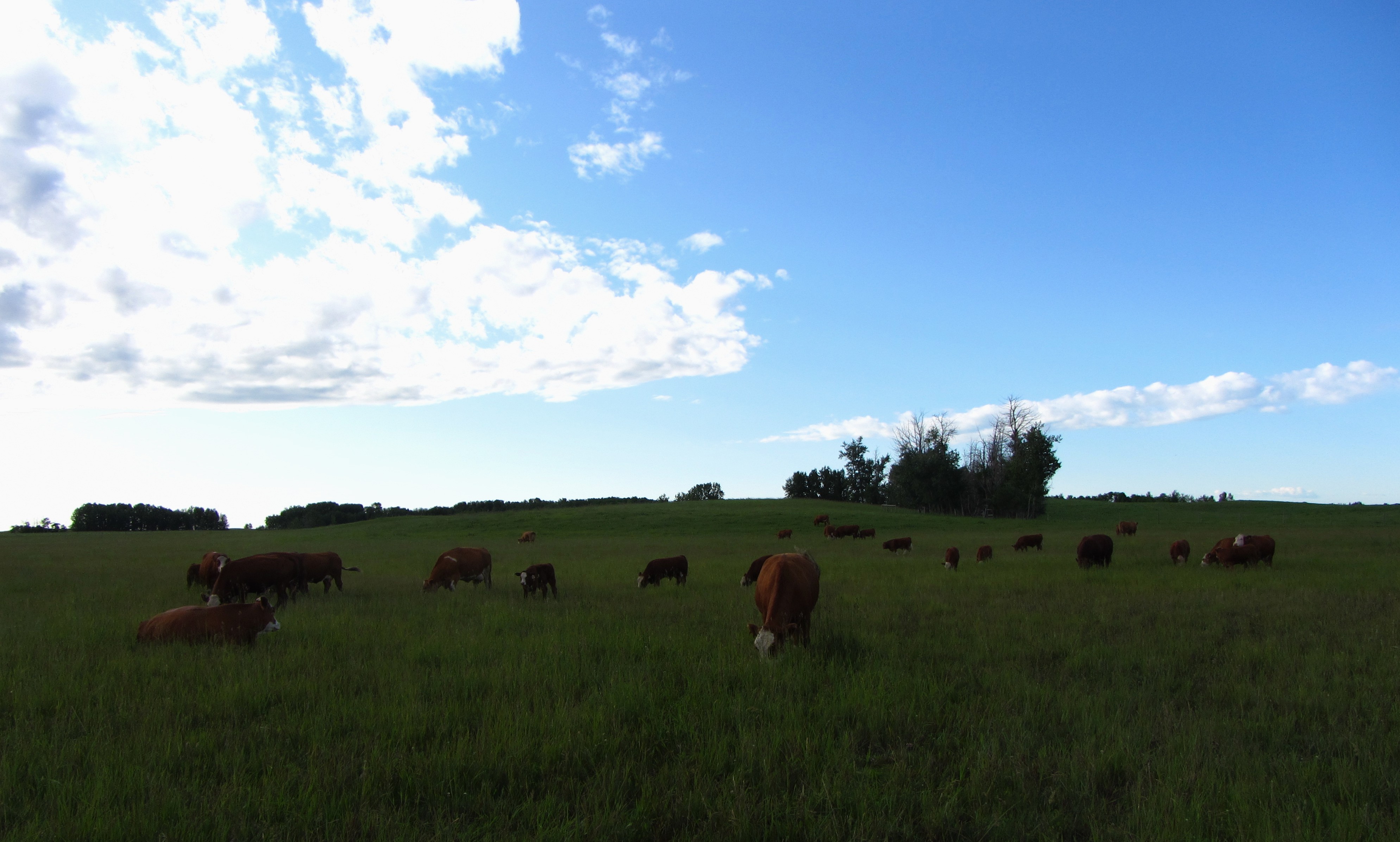
We are fortunate to be able to house all of our cattle here at home, and although most of the pastures are visible from the front porch or back deck of our house, there is still nothing better than a cow tour.  I like to spend hours just watching cattle on grass. Seeing them eat, at peace in their natural environment. Looking, studying the cattle from all angles. Checking udders, feet, and body condition – are they gaining weight back? Or is it all going to their calves? After a hard days’ work, it sometimes gets real tempting to sit on the deck with a beer and binoculars, but nothing replaces taking the time to spend walking the cattle.

It is also great to watch the calves develop their own identities – and go through growth spurts. Calves can be difficult – they can look great one day – then seemingly shoot up three inches overnight and turn a little gangly – before bulking up on their newly expanded frame. Some calves always stand out.  Often there is a calf that jumps ahead of the pack and stays there (2010’s Ensign was a great example of this, and we have another one this year). Other calves grow on you – they are often ‘just a calf’ until one day you get a longer look, and are impressive individuals in their own right.  Without spending the time, maybe the wrong decisions will get made come weaning – it might be a minor thing – one or two kept instead of culled per year . . . but sooner or later these small decisions can add up.

I always try to take at least some holidays at the end of June. Not only to coincide with the end of Jeanne’s school year, but also so that I have time to tour the herds of fellow breeders. Everyone has a slightly different management style, and a different vision of what the future will demand from Fleckvieh genetics. Being able to tour other operations provides a great opportunity to learn something; whether it be unusual genetics to evaluate, a unique pasture management system, or for an early peak at the next years breeding stock selection.  I have yet to tour a herd that I haven’t be able to bring something home to incorporate here at Applecross.

And I think that is the key – to not only tour herds, but also to compare herds back to what we are trying to accomplish here.   So the first thing I do after touring a herd, is to go back out to re-evaluate our own operation – how do we stack up?  Do they have best practices we can easily implement to make improvement? – are there genetics that I have seen that maybe should be utilized in a future year? Successfully cattle breeding is all about constant improvement, and gaining exposure to a lot of different operations in order to widen your knowledge base can be very valuable.  June seems to be the best time of year to ‘get your boots wet’ (literally this year); utilizing all that extra daylight to spend more time with the cattle.

While I do think Genomic Testing is very important (I will elaborate my thoughts on DNA in another post here shortly), spending time with cattle to complete that physical evaluation will always remain an essential part of the business. Here is to the joys of June – long days, warm, (hopefully) sunny weather, and lots of time for cattle – on pasture, turning grass into meat and milk. Happy touring!