Our Journey as Producers of Fleckvieh Simmental Cattle.

Latest

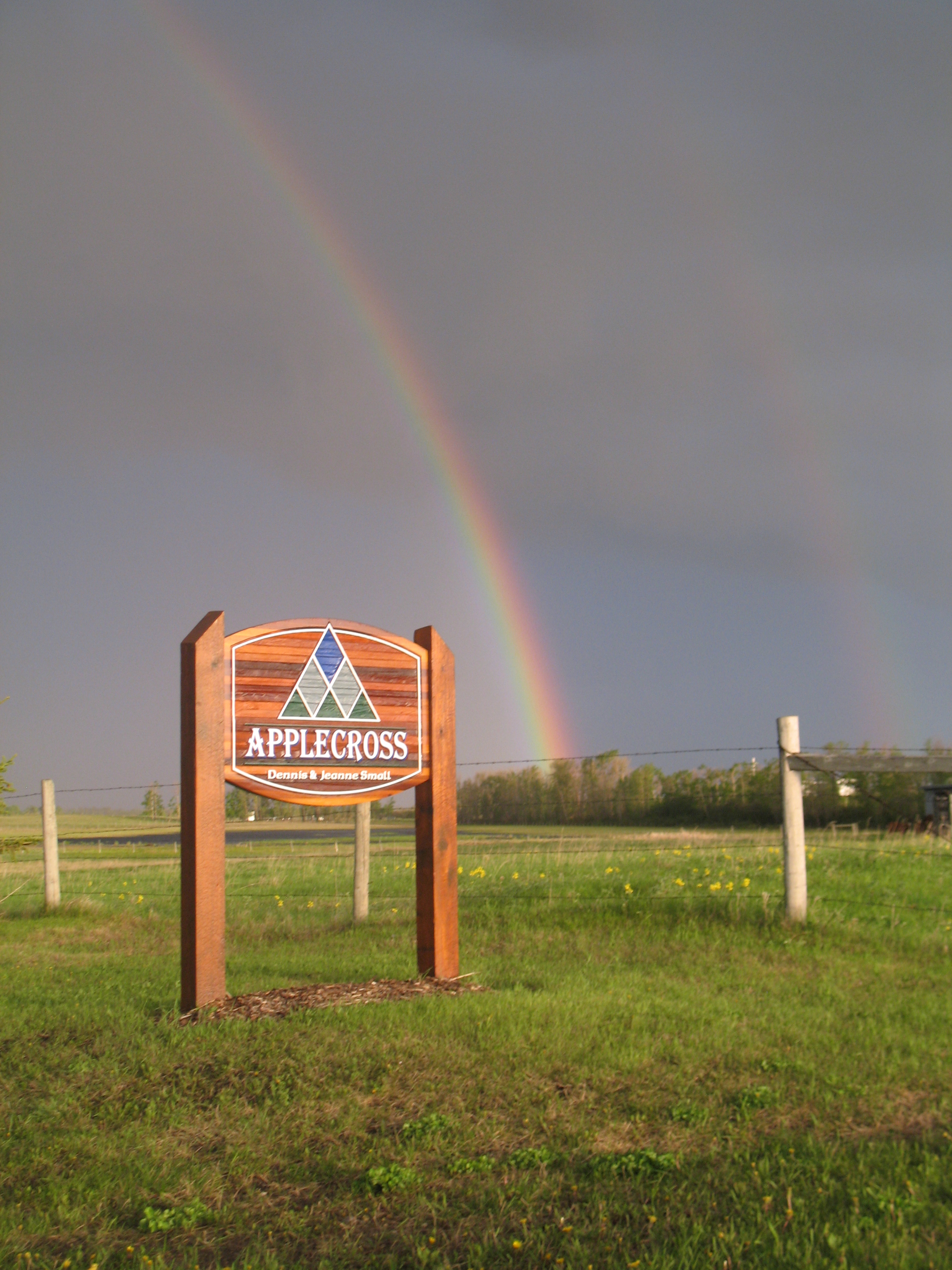
Thunder & Colour


One of the beauties of central Alberta is the thunderstorms that roll in early evening, last for an hour and are then gone again, leaving in the quiet calm the smell of clean, fresh air and often a lingering rainbow or two.  With the storms however, always comes trepidation – the moisture is always appreciated, but the threat of hail and that dreaded white combine is a major concern.


May Long Week-end: A Time to Fence

For as long as I can remember, it has been a family tradition to fence on Victoria Day Week-end.  It is usually right around this time that the cows go to pasture, so it is a matter of importance to ensure the fences are all up, in good repair and that ‘heat’ is on all the hot wire cross fences.

Back in the early years, the family farm had quite a number of rail fences.   For those unfamiliar with these, Ontario was predominantly forest when it was settled.  Early pioneers cleared the land and kept a lot of the timber around for future use.  One of these uses was the backbreaking task of splitting cedar logs into rails, and then using these rails to build fences.  While the fences were functional, they did provide perfect scratching posts for cows.  A year full of scratching often meant that the rail fences needed a lot of repair come spring.   Gradually over time, the rail fences have been replaced primarily with high-tensil hot wires, but a few areas of rail fences remain.   I find it quite amazing that well over 100 years since the land was cleared, the rails from the early settlers are still in use.    Today’s picture is one from Mom at Dora Lee – from the lower yard looking out toward the pasture.  It gives a great indication of what rail fences look like.

Here at Applecross, our fencing is a lot more straight forward.  Our farm is fenced and cross-fenced with 4 strand barb wire, and then we have reinforced this with a hot wire.  We have also begun
cross-fencing into even smaller pastures via single strand hotwire, to allow for different management groups and more rotational grazing.   With land prices where they are at in Central Alberta, we are trying to maximize the grazing potential of our property.  Our goal is to have 3 management groups (bred heifers, bull calf pairs, heifer calf pairs), with 3 sets of  rotational grazing for each group. Each
paddock should hopefully have 10 days of grass, allowing a 3 week break between grazes.  Obviously moisture conditions and the season can speed or slow the rotation, but having options and trying to
maximize our pasture production remain our primary goals.

With the late arrival of spring in Alberta, we seem to have skipped right to summer: 20 degree days and lots of daylight have accelerated the pasture growth, so it looks like our cattle will be able to go to grass next week.  Walking the pastures looking at cattle is one of my favourite activities, so it will be great to get them out – in the interim, there is lots of fencing to finish, but thankfully no rails to worry about!

Happy Easter!

APLX Santana 11Y

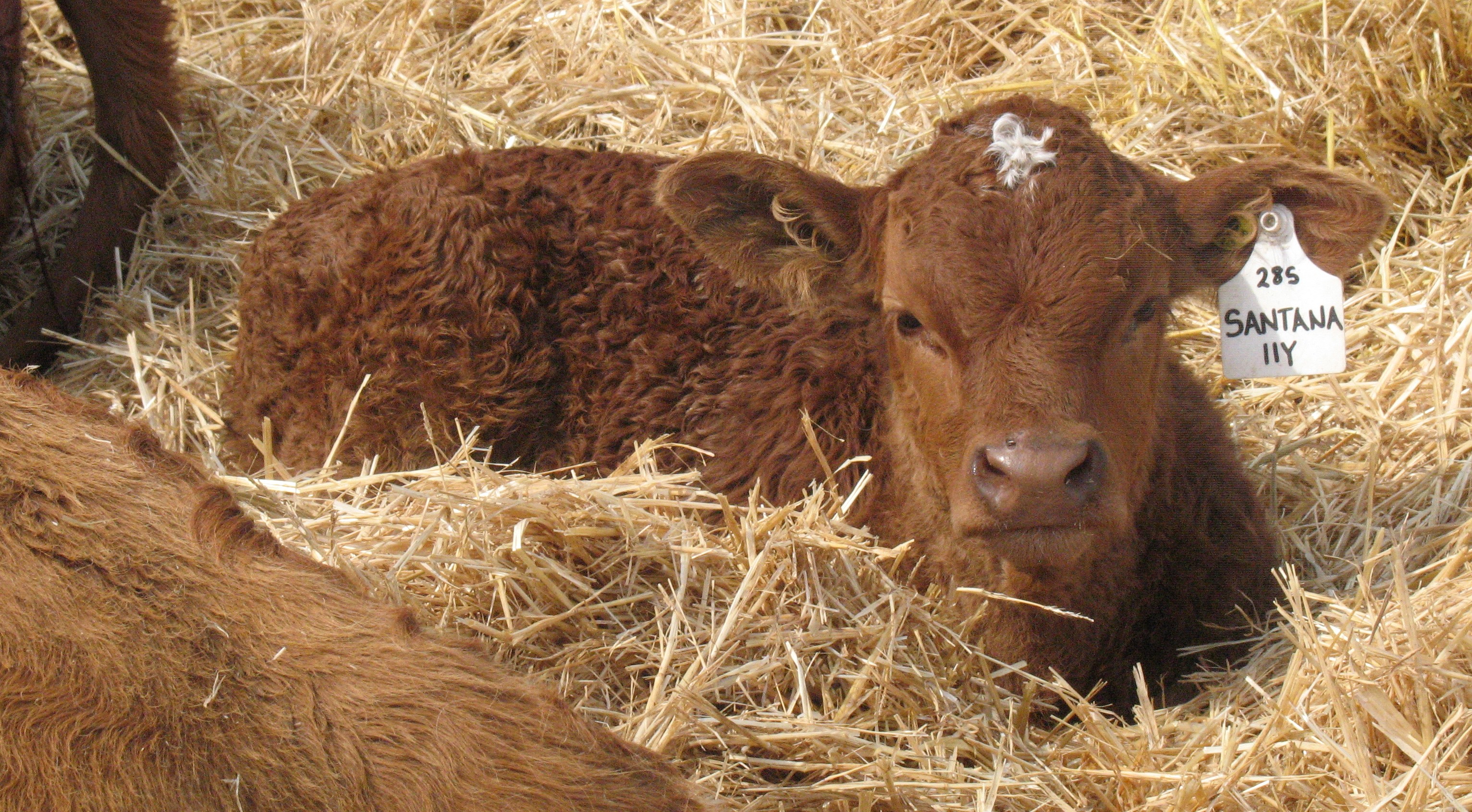
Happy Easter from Applecross.   As we pause to reflect on this week-end holiday, we remember that Easter has always been about rebirth.  In this years’ case, it has coincided with (finally) the onset of spring, and the rebirth of the land from a long winter slumber.  We have had more snow this year than we’ve experienced in our time out west (according to lifetimers, the most snow since 1974), and an unseasonably late spring has lead to our snow pack just melting down now.  Spring is about 3 weeks behind, but if the next few weeks can stay this warm and sunny, hopefully we’ll be able to catch up and still have the cows to pasture in late May.  One advantage of the late spring is the slow melt of our snow (we had about a foot and a half base), which should ensure lots of grass come summer.  We have the moisture, now let’s see some heat!

Pictured here today is Santana – a mid-March calf from Dora Lee Christina and Spruceburn Starfire.   While only just over a month old, he is developing into a good bull calf already.   Probably the most unique thing about Santana is his colour pattern.  The small white dot on his forehead, is the only white on his entire body – he is almost entirely cherry red.    While we don’t necessarily breed for colour; I do try and breed for eye pigmentation, and whenever I am on cattle tours I always take a second look at cattle with white (a topic for a future post).  Santana has quite a unique colour pattern, but hopefully it will be his length, volume and style that we’ll be talking about when we go to make our final bull pen selections in September.

Once again, Happy Easter.  We hope that you are enjoying this special day with friends and family; and are also experiencing the return of wildlife, nesting birds (and nesting calves), in this glorious rebirth of spring.

How We Name Calves

A Handful of our 2011 Calves


Maybe it is because our numbers are relatively small, but naming cattle is one of our favourite parts of calving. We give it a lot of thought, and we do have certain parameters we like to follow.   As we mentioned in an earlier post, we tend to follow the dam’s name on heifers and sires name for bulls.  Thus, Equinox bull calves became Ensign, Emmett and Eli, whereas heifer calves from Tasha became a Tara and a Taylor.    For some reason we also decided to prefix differently for each sex.  Boys get our herd letters APLX, while girls get the full farm name ‘Applecross’.

Originality also counts; especially for the boys.  There are certain names in the Simmental breed that, in my mind, stand for one individual and can only be reused selectively.  For example: when someone says ‘King Arthur’; I still think old school Fleckvieh Legend, rather than the recent upcoming red sire.  When I hear Rachel, I think 29X.  And, as a more recent example, when I hear Romano, I think ‘Champs’.  With a lifetime of involvement in the breed, my list of legendary names might be getting long, but I think it is important to stay original, and recognize that name association is the pinnacle of success for an animal. But until that animal hits ‘elite’ status, I think that name is pretty fair game.  

Jeanne, being both a public school and Scottish dance teacher, seems to have an endless supply of ‘appropriate’ names for animals; but she also has a few names on the veto list.  If a student’s behaviour is horrible, chances are they will NOT have a calf named for them.  Speaking of vetoes, we both get one.   If we each absolutely hate a name, or if I feel it falls into that ‘Legendary’ category, there is no point using it.  Marital harmony is a good thing.   Having a calf named something that either one of us dislikes tends to lead towards a short stay at Applecross, the use of nicknames like ‘freezer’ or ‘burger boy’, and an excuse to get that animal off the place as soon as possible.

Once we run out of good names that start with the same letter, we still try to connect the dots.  Thus a ‘Princess’ will have a ‘Baroness’, ‘Countess’ or maybe ‘Duke.’  In our case ‘Treasure’ yielded ‘Jewel’ who in turn gave us ‘Ruby’ in 2010. Maybe someday ‘Ruby’ will give us a ‘Tuesday’ . . . as long as I can convince Jeanne!

Before we finalize a name, we do one last test.  We take the proposed name and imagine Jay Good or Dan Skeels saying that name off the block at auction.  If we can’t imagine them saying it correctly (whether it is pronouncing ‘Hermione,’ or saying the phrase, ‘out of the Thruster bull,’ with a straight face), then the name doesn’t get used.  While Jay and Dan are both consummate professionals, it doesn’t hurt to try and make their jobs a little easier.  Sometimes what sounds cute at birth, can sound pretty silly when that bull or heifer shows up in the sales ring or in a pedigree.   

With the above criteria, we add appropriate names to our calving sheet for both daughters and sons.  One name each, with the ‘quality’ of name dependant on the anticipated calf quality.  Then once the calf is born, we immediately give it it’s name. We do sometimes change the name immediately following birth (or try to think fast and add a name for twins), but once a name has been chosen, it usually tends to stick.  Also, if we anticipate steering or culling the calf, we give a generic name (Bill, Joe, Bob) as opposed to ‘wasting’ a good name.    Throughout the years it feels much more natural being able to call the calves by name, rather than by number.   Maybe it makes us more attached to that calf; but the name always seems to become part of their identity.

After explaining all that, maybe our naming strategy sounds complicated. We think it makes sense; and with both of us having input, it tends to be fairly balanced.  I may not get to name every bull calf after a truck (although I did sneak through both an Envoy and an Escalade in 2011), and Jeanne may not get to use the names of all of her favourite Harry Potter or Twilight characters (she snuck in an Emmett!), but the middle ground tends to yield a good name – distinctive but not outlandish.   Here’s to happy naming – it is yet another fun part of breeding cattle.

11th Annual Red Deer Simmental Bull Sale Report

The 11th annual Red Deer Simmental Bull Sale wrapped up Monday, and overall we are quite pleased with how our first ever sale turned out.  Despite some prior-to-event setbacks, which resulted in both Emmett and Eli withdrawing from the sale, Ensign carried the APLX prefix very well.

A foot of wet March snow created very poor weather, but a capacity crowd was still on hand to see 80 bulls sell.  Sale stalwarts Oh Kay Farms led off the sale with the first 2 lots; with Ensign selected to be 6th in the ring.  When the gavel fell, Ensign sold for $8,000 to Langer Fleckvieh of Edson, AB.  We are quite pleased with the result, and as an added bonus, Ensign was the high selling Fleckvieh bull of the day. Ensign has a great new home, where we are confident he will work well with the Langer herd for many years to come.   We look forward to Ensign’s genetics showing up in the Langer’s sale string in future Fleckvieh Equation Sales, held each December in Red Deer.

Other sale highlights include fellow first time consignors, WJ Simmentals, selling their red bull ‘Label Me Teddy’ for $10,250, and the overall high seller of the day ‘Oh Kay Zanadu’ selling for $15,000.   Overall the sale grossed $344,200 on 80 lots for a $4,303 average.  We were also quite impressed with the results of the Beechinor Bros. Simmentals program; their 28 lots represented over a third of the bulls sold, which showcased the strength of both their Fleckvieh and purebred cow herds. 

Optimism has returned to the cattle business, and we were pleased to be a part of this great event.  Transcon put on a heck of a sale, and we look forward to taking part in the 2012 edition next year.

Our Entries to 2011 Red Deer Bull Sale

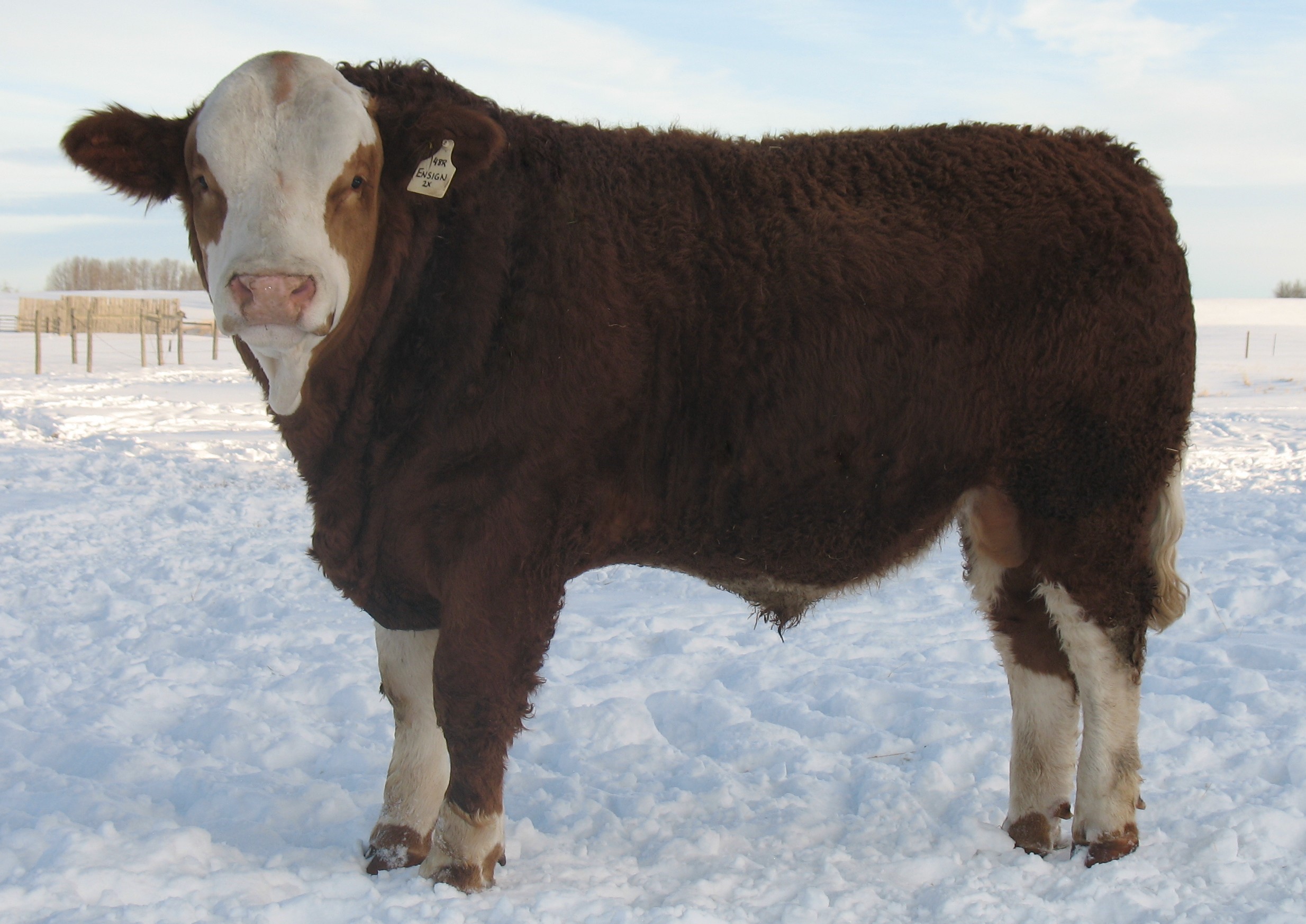
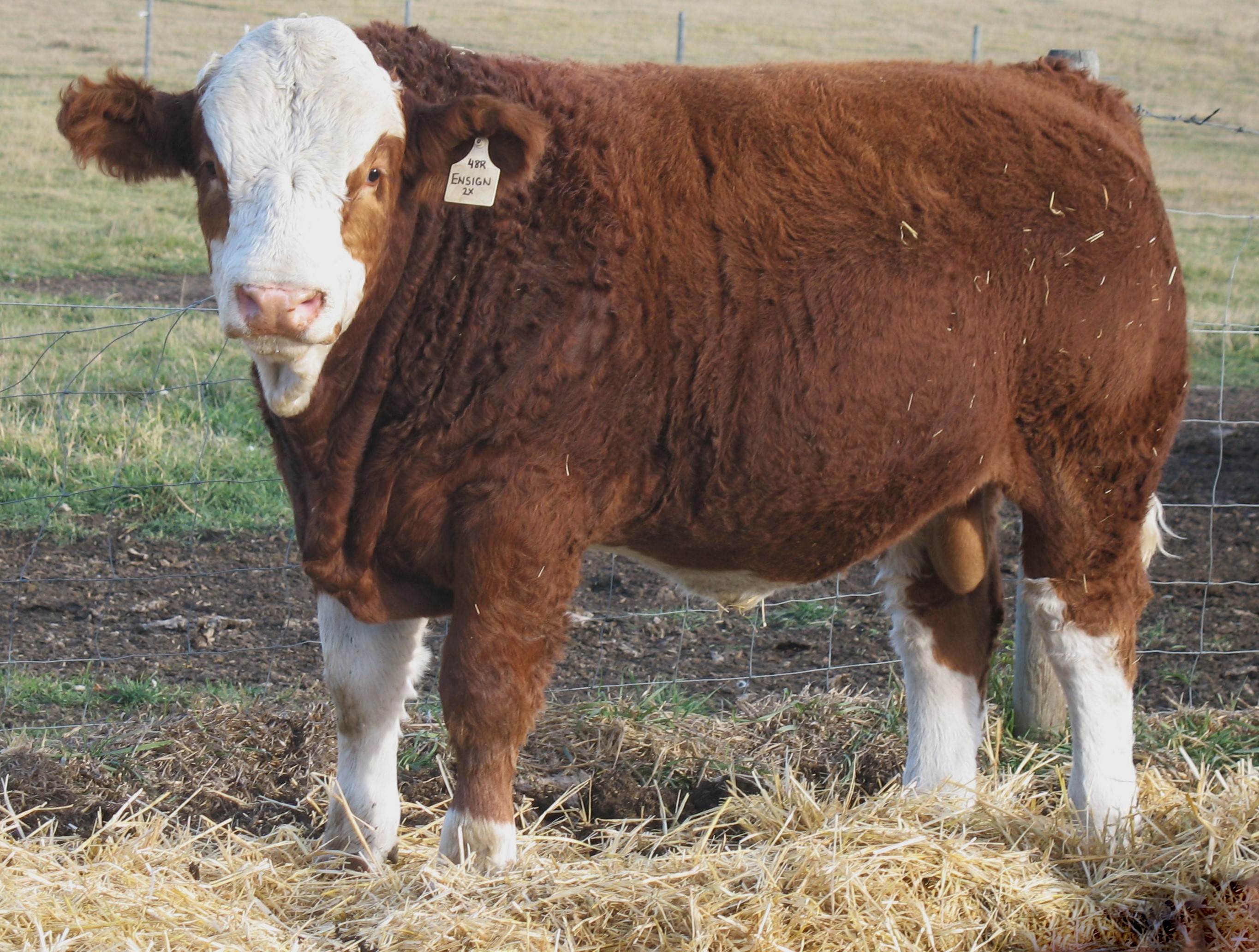
APLX Ensign 2X - headlines our entries

Individual pages (short-cut links are located in the right-hand column) have been created for our three bull entries to the 2011 Red Deer Bull Sale to be held on Monday, March 21, 2011 at 1:00pm at Westerner Park, Red Deer, Alberta.  The 2011 edition will represent our first genetics to sell by auction, and we are pleased to be a part of this great event.

The three bulls selected represent the best of our 2010 bull calf crop.   We weaned September 3rd, 2010, evaluated the calves, and then culled thoroughly.  These three bulls are all solid colour, heavily pigmented, have moderate (90-100lb) birth weights, show lots of muscling, have tremendous hair coats and are backed by strong, often unique, pedigrees.  The bulls have been developed on a ration of free-choice quality first cut hay combined with 10lbs/day of mixed grain, formulated to 12% protein.    To ensure they are in shape for breeding season, the grain ration was increased to 12lbs/day on February 1st.   The bulls are housed in a 5 acre paddock to ensure lots of exercise, they have all been at least tie-broke, and all have a quiet temperament.  In short, we have raised them to be the type of bulls we would wish to buy for ourselves, and feel they will go out and get the job done.

Thanks to their sire, all three bulls are scurred and may pass the polled gene along to their offspring.  In 2009 we were selected to help ‘prove’ an exciting new homozygous polled bull that was the result of 10 years of development – Dora Lee’s Equinox.  We are very pleased with how his first calf crop has performed, will continue to use him extensively.   Thanks to his development in Ontario, we also believe his genetics are outcross to the vast majority of Fleckvieh lines in Western Canada.  These three bulls will also represent the only Equinox sons to sell publicly in 2011.

On the individual pages, we have also pictured the dams.  Maternal lines are very important to us, and we feel that behind every great bull is an outstanding mother.  We also have additional information and pictures available about the maternal grand dams; should it be of interest.  As some people prefer paper copies, we also have individual bull profiles available in PDF format that can be e-mailed and printed, or sent by regular mail.  Please let us know if you would like any additional information on any of our animals.    

The 2011 Red Deer Simmental Bull Sale will be a very exciting time for us.  We look forward to seeing the first Applecross genetics sell March 21 at Westerner Park.    

Picture Note:  The above picture of ‘Ensign’ taken in October of 2010.  We really like this picture of Ensign, as it showcases his tremendous volume and heavy muscling, but wanted to use a current ‘winter’ picture in order to have consistent maturity with the other bulls in the catalogue and on his web-page.

Reference Sire Page Added

We have just added a reference sire page, located under the Herdbook tab at the top right of our website.  Our reference sires consist of the three bulls that we have utilized that are privately owned and/or only selectively available through AI; and therefore may not be as familiar to those in the industry.  We expect the number of ‘reference sires’ to grow as our herd continues to develop and evolve.

Why February is the best time of the year

On the morning of February 1st, it was -36 here.  Call me insane, but I think February is the best time of the year to be in the purebred cattle business, despite the temperatures.  (Of course, I also think June and October are the best time of the year, but I will get to those months in the future).   Why February?  Only because it is probably the most important month of the year for purebred breeders.    It is the month major breeding decisions get made – and those decisions will impact your breeding program for at least the next 5 years, and potentially shape it for decades.  In short, it is the month of opportunity.

In February, there are January/February calves on the ground that are developing, and providing an early glimpse of their potential.  They create a short window to determine what matings from last year appear to be working.  There are so many questions to be asked and answered:  How easily did they calve? Were the calves vigourous? is the colour/pigmentation what you expected?  Is it the sire? Is it the dam? Was it just the wrong combination of genetics? What is the early performance/muscling/femininity like?  All of these questions impact the decisions that must be made this month.

In the mail there is a steady stream of bull sale catalogues, followed by sales to attend, and fellow breeders to chat with and learn from.  Not only are bulls to be selected for your own use, but also the inspection of different bloodlines, cow families and breeding programs are very important.  Not to mention the constant comparing to your own bulls back home – how do your bulls stack up against those of your peers?  What can you learn from your peers to make your breeding decisions/marketing program better in future years?  What are the current industry trends?  Should you follow those trends within your operation?  What are your customers telling you about the genetics they purchased from you last year, or the year before that?  February provides the opportunity to network, and obtain this important feedback.

Finally, after doing the evaluations and answering all of those questions in your own mind, the breeding decisions have to be made.  At Applecross, we continue to expand our numbers, so we continue to utilize AI as much as possible in order to broaden our genetic base, before turning out the bulls to finish things off.   In February, a lot of time is spent with our projected breeding chart, the chart that highlights the all of our options and our best ideas.  But potential matings can still change half a dozen times between February and mid-March.   We don’t always get what we want either – AI matings can come back; we can change our mind at the last minute and then regret the change a day later, but all in all, February is the month of opportunity.  Stressful at times trying to make a good decision – one that you won’t know the answer of for 5 years; but an awesomely exciting time to get to pull the trigger and make your choice.

February.  The month of decisions.  The month of opportunity.  The best time of the year.

Of (Gorgeous) Gretchen and (Amazing) Grace

Dora Lee's Gretchen with dam Geneveve on pasture - summer 2009

In 2009, while on a short summer visit to Dora Lee in Ontario, Dad and I took several tours of the cow-herd.  It is sometimes nice to be away from the home farm for a while.  When you come back, you notice changes more readily – specifically the younger cows who have developed a lot in the course of a year.   The summer of 2009 was wet in Ontario, and in mid July the cows were still up to their bellies in grass (indeed, in the river flats, we were peering through grass that was over the height of the gator to see cattle).  This was a sharp contrast to the dry year we were having in Central Alberta, where the pastures were already beginning to show stress.    

Jeanne and I were still only a couple of years into developing Applecross and, despite an amazing set of heifer calves of our own, I was determined to continue to expand our numbers – and add at least one more Dora Lee female.  Mom and Dad had developed quite a number of impressive cow families over the years.  Although I had already tapped into a number of them, there were still a couple of others that I wanted to try and obtain genetics from.   2009 was also the year Dora Lee Eclipse came into his own – he put a clear stamp on his heifer calves (they always seemed to stand with their heads up; showing off their long neck with lots of power).  He also had quite a number of impressive bred heifers and first calvers.  We already had three Eclipse females of our own, but all three were horned.  Thus, my objectives were defined – find a polled Eclipse female from an outcross cow family.  If I was really lucky (and the price was right), maybe I’d be able to find two heifers (or even better, an instant cow family in a cow-heifer calf pair).

After touring the herd several times, I held my cards close. I had my eye on three calves and one pair – but what was Dad willing to sell?  He named a price and gave me pick of the entire heifer calf crop.  While the price was higher than I had hoped (and eliminated the pair idea), I couldn’t have asked for more selection, from what was an amazing group of heifer calves.  Dad, knowing we were in drought and short grass, also offered to winter her, AI her to the bull of my choice and then have her delivered in the spring.   It was a really great opportunity – but what to pick?

I took Jeanne out for one last tour.  Jeanne gives me a pretty free hand in selecting cattle, but always has (good) input, and has a big influence on naming the calves (both here at Applecross and previously at Dora Lee).   After seeing the four calves I was interested in, we selected a polled Arnold’s Image daughter from an Eclipse dam.  She was a younger (March) calf, but exuded femininity and was cherry red to her hooves.  I am also a sucker for older proven genetics, and had always wanted an Arnold’s Image female to walk beside some of the other classics we already have (King Arthur, C&B Western and Antonius).   Picking an AI sire was easy – LJB Jade.  I was with dad when he bought the semen, and we had debated his merits many times.  The combination of outcross genetics, calving ease, and knowing he sires powerful females himself, made Jade a quick decision.       

While Jeanne and I name calves at birth, Mom and Dad usually wait until weaning is done; which also gave us the ability to name our new heifer.    Our new calf’s mother was named ‘Geneveve’, and traditionally we follow the dam for daughters and the sire for bulls; leading to the requirement of a ‘G’ name.     This led to the inevitable sit-around-the-kitchen table and throw names out.  It often gets quite silly, but is always a lot of fun – especially since Jeanne and I each have veto power over names.    Dad came up with ‘Gorgeous’ – simply based on her appearance, and how she stood with her head up – as if she knew she was gorgeous, too.  Unfortunately, Jeanne vetoed ‘Gorgeous’, and we eventually settled on ‘Gretchen.’  Although for the rest of that year, Dad and I both talked about ‘Gorgeous’ and how she was developing.

In May 2010, Gorgeous – I mean Gretchen – made her trip west, safe in calf to Jade, and settled in nicely at her new home in Alberta.  She was the first cow due for us, and we anticipated a New Years baby.  Early on January 2nd, 2011, Gretchen gave us an unassisted heifer calf.  Cherry red, with a single goggle, she has lots of neck and is already showing  thickness.  She also appears polled.  While in some ways I was hoping for a bull calf (seems hard to find outcross, calving ease herd sires), I am not disappointed in the least.  She has been named ‘Grace’, and was promptly nicknamed ‘Amazing’ by Dad.  She is amazing – and we are amazingly lucky!  Grace had a 25% chance of being a polled female, with the odds even lower that she would also have the colour pattern and phenotype that we think will make a powerful cow.

Thinking back to 2009 and our goal of adding an outcross cow-calf pair to our program; 2 years later we have been incredibly lucky to have turned the purchase of one, top-end heifer calf into just that.  We really enjoy developing cow families, and a polled Arnold’s Image female walking beside her polled LJB Jade daughter is exciting for us.  They are a great young pair to help anchor our herd, and an ‘Amazing’ start to the ‘Gorgeous’ cow family here at Applecross.

2011 Calving Season – Half-way home.


We are officially half way finished calving – so far, so good.  We survived a couple of really brutal weeks of weather; during which, we were fortunate enough to convince the cows to calve inside.  The calving barn is at least out of the wind, and not quite as cold.   This week has been mild, so it has been nice to see the calves bouncing around the yard playing.

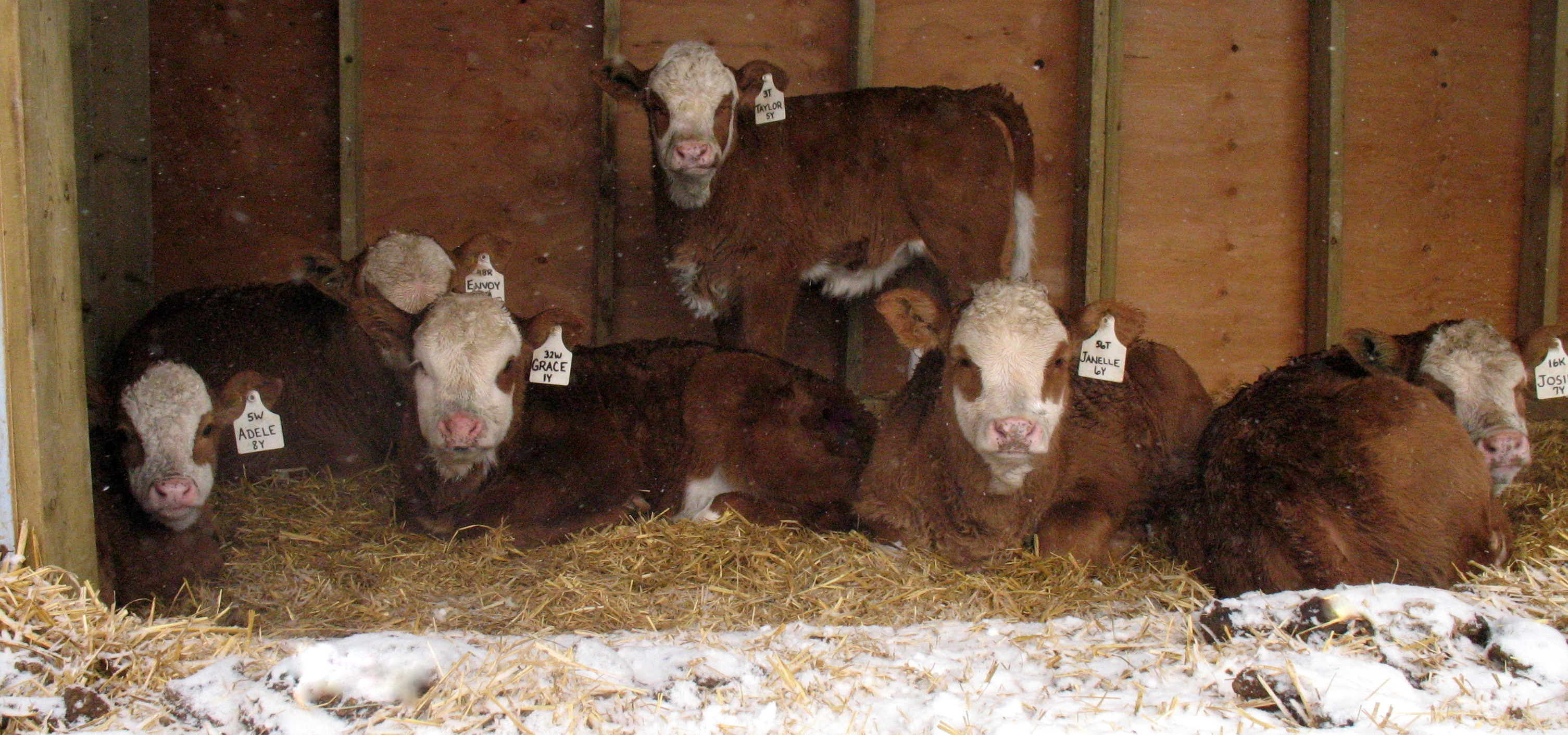
There have been a number of interesting calves to date; both bulls and heifers.  Pictured here are two of the girls – (5 day old) Taylor who is a Gidsco Appollo by our Hiemstra cow, Tasha; and (2 week old) Janelle, an Anchor T Ikon heifer from Dora Lee Jasmine.  We think very highly of both dams (they are both featured on our ‘Young Guns’ page), and we are excited to be able to grow both cow families.   I hope to feature some of our other exciting calves in future posts.