A (very) Little Prayer
It was a miserable, blustery, late November day – the kind of day that makes you feel in your bones that winter was right around the corner. Our corral cleaners were finally finishing up in the yard – getting the manure spread on our pastures to support another growing season. Despite all of the planning that we do, there always seems to be a frantic rush to get the fall work done while we could, and prepare our winter ‘calving quarters’ for another year. The cows had already been moved ‘home’ – not quite to the corrals that were now freshly cleaned, but close enough that we could see them from the house (and close enough that feeding the cows hay wasn’t too much travel). With calving just over a month away, we liked having our ‘cattle circle’ get tighter, leading to a little closer attention, with daily walkthroughs to see who is progressing to schedule. In most cases, we just wanted to re-establish a base line for what ‘normal’ looked like so that we could hopefully tell when something didn’t look ‘right’.
It was that morning, November 21st, when Jeanne came in after her walkthrough, to share the news: “Paprika is looking off – I think she is aborting”. Paprika was one of our first calf heifers and was a star-headed, big volume beauty that we retained to add to our herd. From our living room window, Paprika’s unique colour pattern allowed us to keep an eye on her. As the day progressed, all the (literal) tell ‘tail’ signs starting showing – she was restless – her tail would go up – and she separated herself from the rest of the herd. Jeanne walked through again at noon and confirmed – Paprika was in the process of aborting. Early afternoon, her pattern changed. She was standing still; licking something on the ground. Figuring that she had passed her fetus, we thought we’d give her some time to ‘grieve’ before getting too involved.
It was about 4pm when Jeanne went out for a closer inspection. The calf was all clean and Paprika was standing over it protectively. Then the calf moved! Much to our surprise. The calf was alive.
So what do you do with a tiny little calf born 6 weeks early? We do what we think all farmers/ranchers do. We do the best we can to the extent of our abilities.
We were fortunate in one sense. This wasn’t our first experience working with a very premature calf. The first time it happened, we were successful with a little girl named ‘Hope’ that had the fight and willpower to survive. And those experiences with Hope made us a little bit ‘hope’-ful, that as things worked out before, maybe they would again! The other side was that, calves born so prematurely tend to be aborted for a reason – so what if we weren’t going to be so lucky with this one?
With thoughts swirling in our heads, we knew we were ‘on the clock’ and needed to get started. The first priority was to get the calf inside to ensure it was warm enough, which would also allow us to have a closer look to determine next steps. Our challenge was, of course, that our corrals were completely ripped apart so they could be cleaned. Virtually our entire yard site at Applecross is modular by design. The thought process is, that there is simply so much more versatility gained by utilizing portable panels that can be moved, reconfigured and expanded over the years – not to mention be moved right out of the way when it’s clean out time! New ideas (and more cows!) meant we had a tremendous amount of flexibility. The downside was, that when ‘stuff’ happens while we have the place apart, it isn’t very conducive to managing a baby calf! We did have gates that we could close to eliminate road access for the cows, so we decided to get the calf, and hopefully mom would follow.
With the two of us, we headed back out to the field to get down to work. Her momma wasn’t really sure what was up, but knew that the little brown bundle was ‘hers’ and something she should be protecting. And if there is one thing I have learned over the years, it was to always be careful around a cow with a newborn. It can change cows. And for a first calf heifer, Paprika was all mama. It took a little back and forth – and both of us – but we managed to get the calf onto the calving sled, and then transfer the sled to the back of the gator. With the calf secured, we decided to head for the barn and get the calf warm – mom could wait until we had the calf stabilized and comfortable.
After finding some straw to make the little calf a nest under a couple of heat lamps, we could finally take a temperature. It was a little low, but not near as cold as we feared. We took a few minutes to assess overall health. Certainly not much hair, the hooves were still soft, and we weren’t sure that eyesight was fully functional (yet). We were happy to determine it was a heifer though. For whatever reason, we have found heifer calves born of trauma tend to have more ‘fight’ in them (and are typically at the other end of the spectrum of ‘big dumb bulls’)…so seeing that she was lively and a heifer did give us a little more hope. We have always been told that getting some milk in the calf was also vital. We weren’t stocked for calving yet, but a frantic call to a neighbour found some colostrum close at hand (thanks Stacey!). With the calf so small, we only made up a partial dose, as we knew she’d only have a tiny tummy.
With the calf stable and warm, inside and out, next step was re-uniting her with mom. Paprika was still looking for her calf, but was really uncertain about heading towards the barn. Thankfully, we have a few cows that we utilize as ‘Judas cows’ (traitors), that know what a grain bucket means and don’t mind following people if they know they’ll get a ‘treat’ at the end of the journey. Once we got Paprika partnered up with a Judas cow and separated from the rest of the herd, our traitor knew to follow the gator, which meant Paprika also tagged along. It (again) took a little bit of back and forth, but eventually we got both mom and our Judas cow to the barn.
The next step was getting Paprika – as a first calf heifer – IN the barn, a place she hadn’t been since she herself was a newborn calf. In a normal scenario, prior to their due date, we train our first calf heifers to come in the barn a few times so they get comfortable being in over night (bribed with a little treat for their time). This process typically reduces stress at calving, as they are ‘more’ used to being in the barn and can focus on their new baby (which is a big enough change!) So again, with the Judas cow (knowing there was a treat involved), eventually we were able to coax the new mom into the barn to be re-united with her baby. We did ensure they had a fair bit of space. We didn’t want mom panicking and stepping on her calf – alone in a barn she had barely been in, that didn’t even ‘smell’ like cows yet this season. But we wanted them close enough together that they could start bonding. Certainly a tricky balance! And with that step complete, we took a break for a couple of hours (but could still check on them from the house via our cameras).
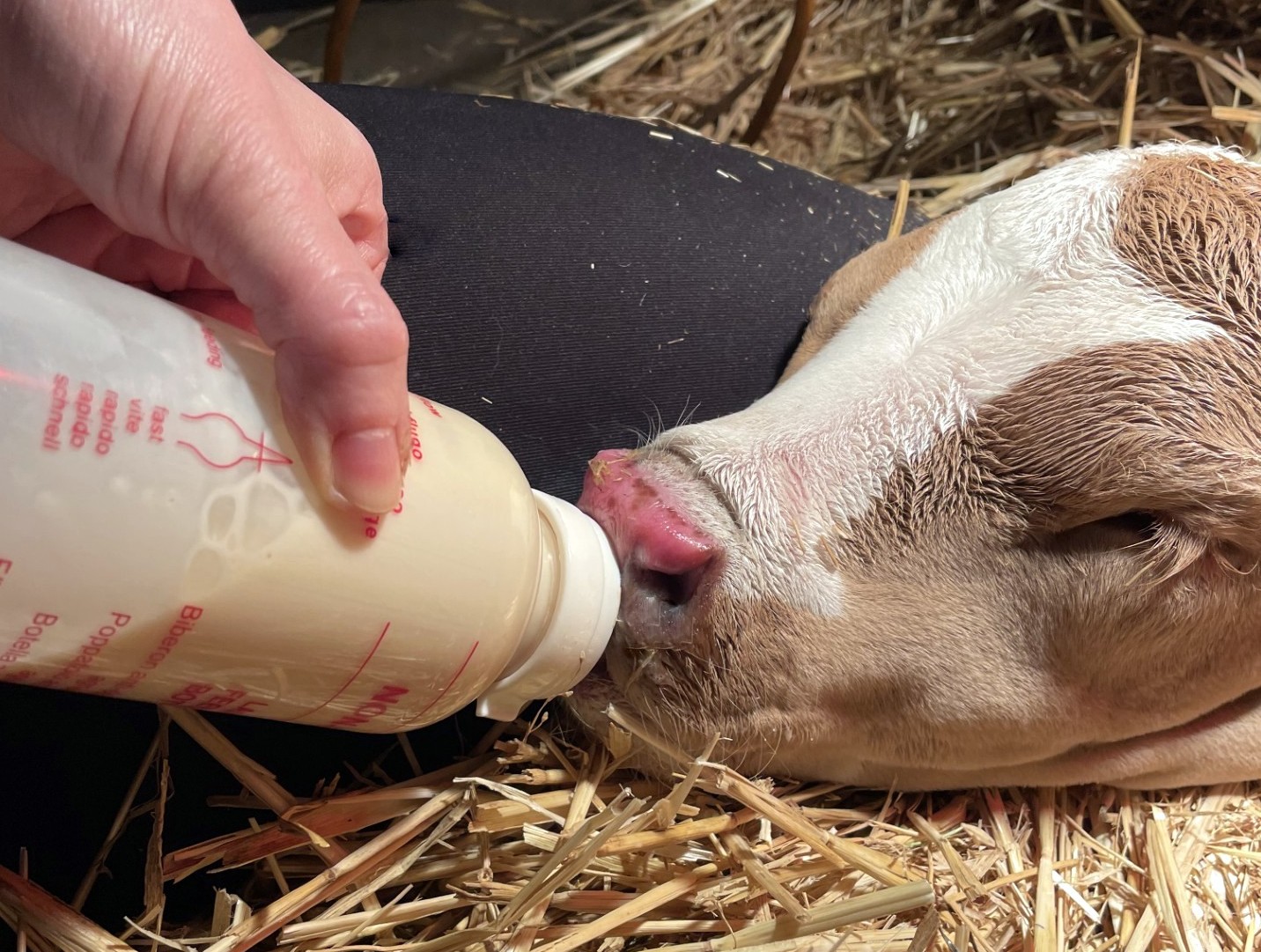
We went back out to the barn just before bed to see if we could make more progress. While store-bought ‘powdered’ colostrum works for emergencies, it has always been our preference to use ‘mama’s milk’ whenever we could. Sensing (if we were successful) that Paprika would need to get used to us working with her, we thought it was time to get her in the maternity pen headgate so we could strip some colostrum. With a foot secured with a rope, mom safely, (but unhappily) allowed us to hand milk her. Equipped with a small milk bottle meant for sheep, that we had kept on hand since our previous experience with ‘Hope’, Paprika’s baby already had quite the suck reflex. The milk from the smaller sheep bottle disappeared very quickly. Sensing progress, tired and exhausted, we went to bed for the night – content that we had done what we could – and hopeful that the next day would bring continued milestones.
This maternity pen routine carried on for the next few days. Jeanne and I worked together to get Paprika back in the headgate each morning; ensuring we also got enough milk for a lunch time feeding while I was at work. Evenings after Jeanne’s dance classes wrapped up, led to another trip to the headgate for Paprika and an evening snack before bed. While the little girl really enjoyed her bottle, we’ve always tried to get calves sucking from their dam as soon as possible, so our next ‘big step’ was to try and get the little one standing so she could start to do more on her own. After giving her a snack, we would work with her to get her legs going. Starting at the back end, we assisted her to tri-pod her back legs to put weight on them. She gradually got steadier and then, with a hand under her chest we helped her stand on all four legs. It certainly was a project, with lots of falls, and not always linear progress, but on the evening of day 3 she was able to stand on her own.
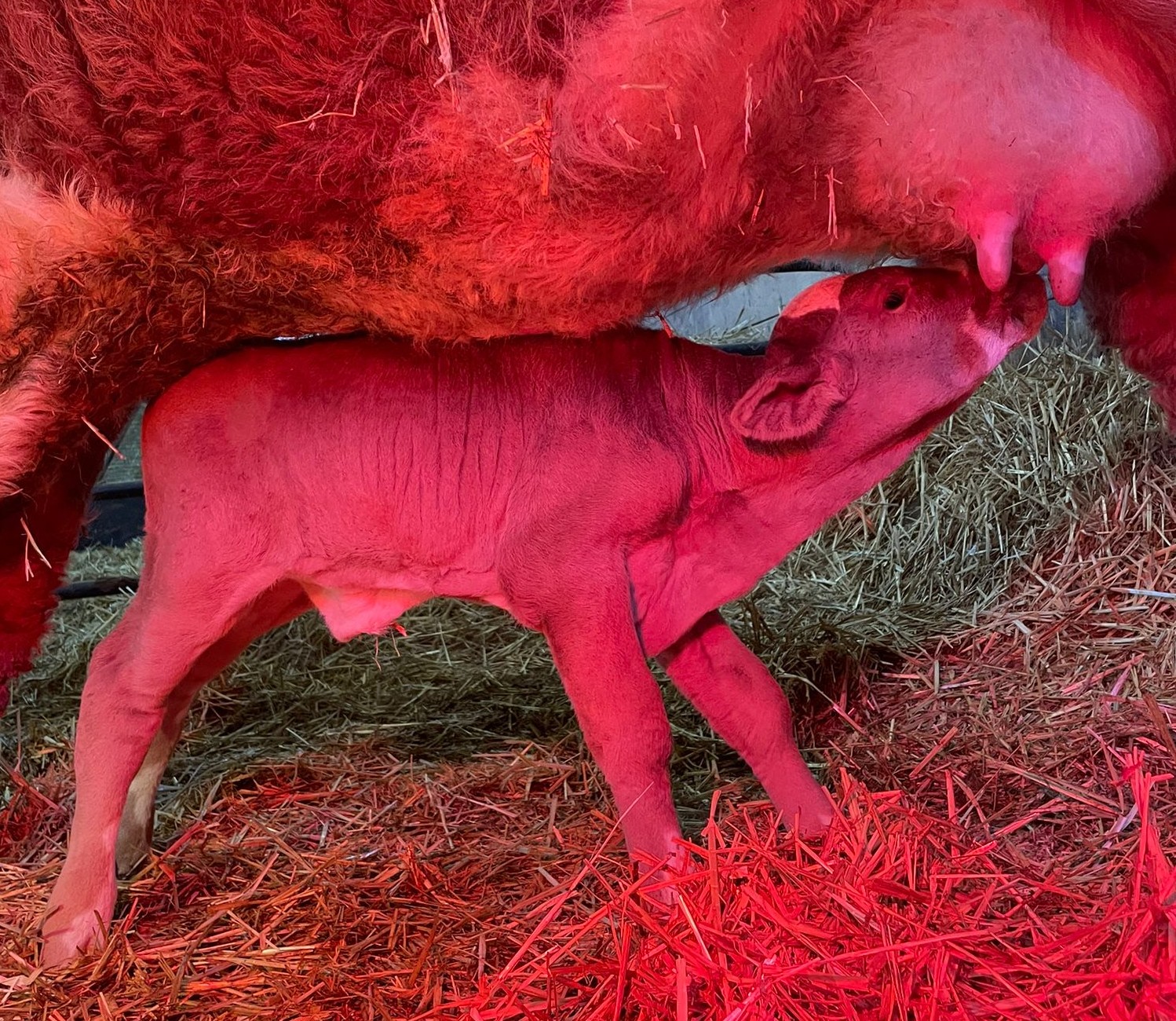
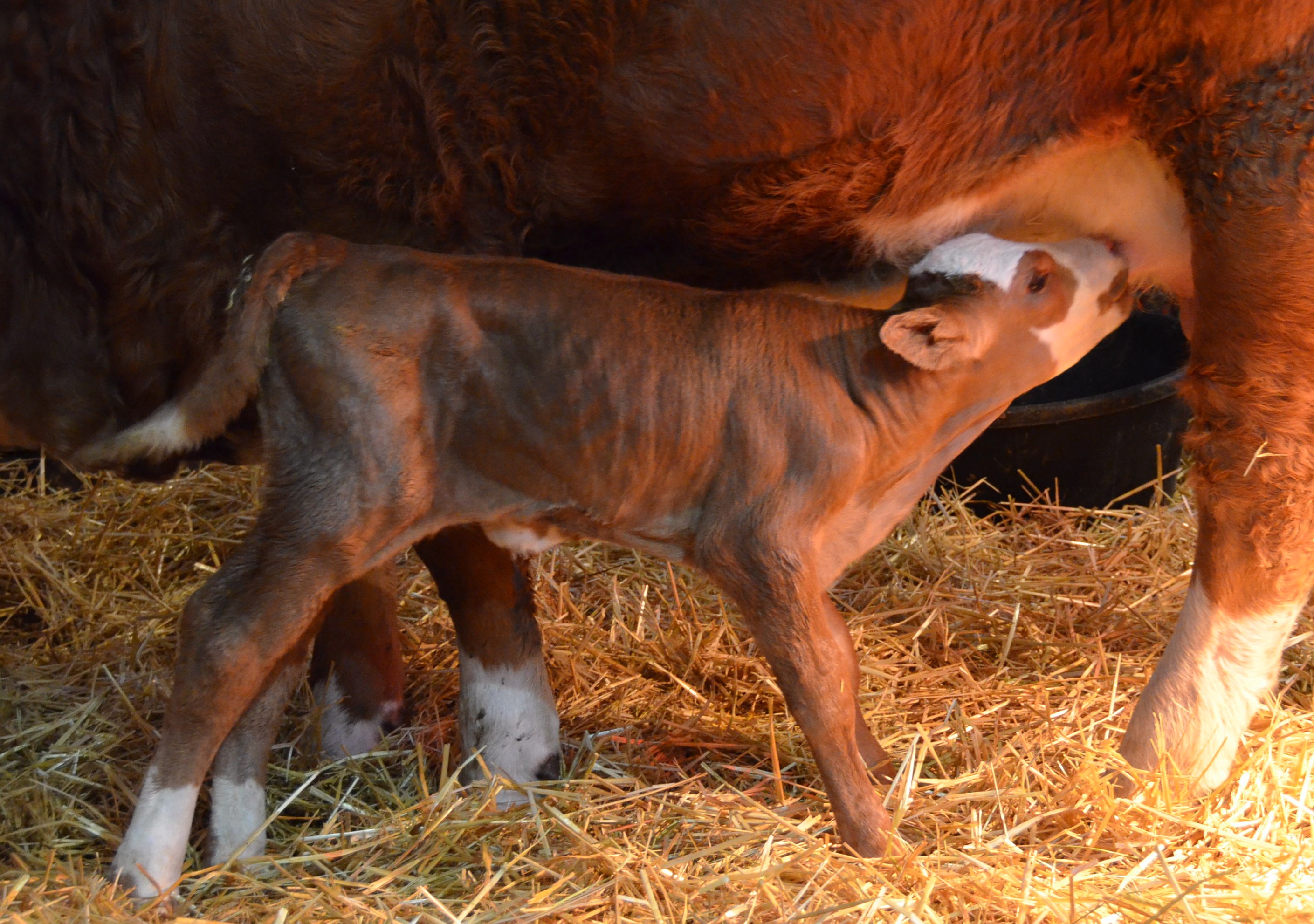
With mom safely back in the maternity pen headgate, our next step was getting her to drink fresh milk from mama. Some continued persistence and with help from both of us, she quickly found the natural spigots – and was very happy there were 4 of them! The next morning brought another trip to the maternity pen headgate for Paprika, and another small drink for her calf. She seemed a little more steady on her front feet, and had more energy. So we started thinking bigger picture. As we had a similar experience (with Hope) a few years ago, we looked back over our notes to see what all we did ‘last time’. We weighed her and she came in at only 40lbs! We also treated with Dex (which helps to lubricate the lungs which when born premature can be an issue), and gave the calf a broad-based antibiotic, as we knew that her immune system wouldn’t have been developed. We also consulted our vet (and some trusted cattle friends) for anything we may have missed, but were cautiously optimistic as the calf continued to make progress. At lunch time, she only needed one of us to help her get a drink, and then 24 hours later she was able to stand and nurse on her own – and could balance herself right underneath her mom! Milestones and progress certainly brought smiles!
With the baby calf gradually improving, our next step was figuring out a name. We had been calling her ‘Two-point-oh’ for the first week (as in Hope 2.0), as we consciously made the decision not to name her for a week because we were trying not to get any more attached than we already were. We always named our calves at birth, and while our numbers have increased over the years, it is a process we still find both manageable and fun. For heifer calves we typically follow the name of the dam, and in this case, Paprika was the legacy of our popular (and prolific) ‘P’ cow family that started all the way back in 2010 when we acquired Spruceburn Pauline as a bred heifer. Pauline gave us ‘Poppy’ who gave us ‘Piper’, who gave us ‘Pepper’ who provided us with “Paprika’, so the new calf would be the 6th generation of this cow family to walk here. After a fair bit of consideration, there was one name that seemed to fit for our premature little baby: ‘Prayer’. Certainly a lot of thoughts were sent skyward during the formative hours of Prayer’s young life, so the name stuck.
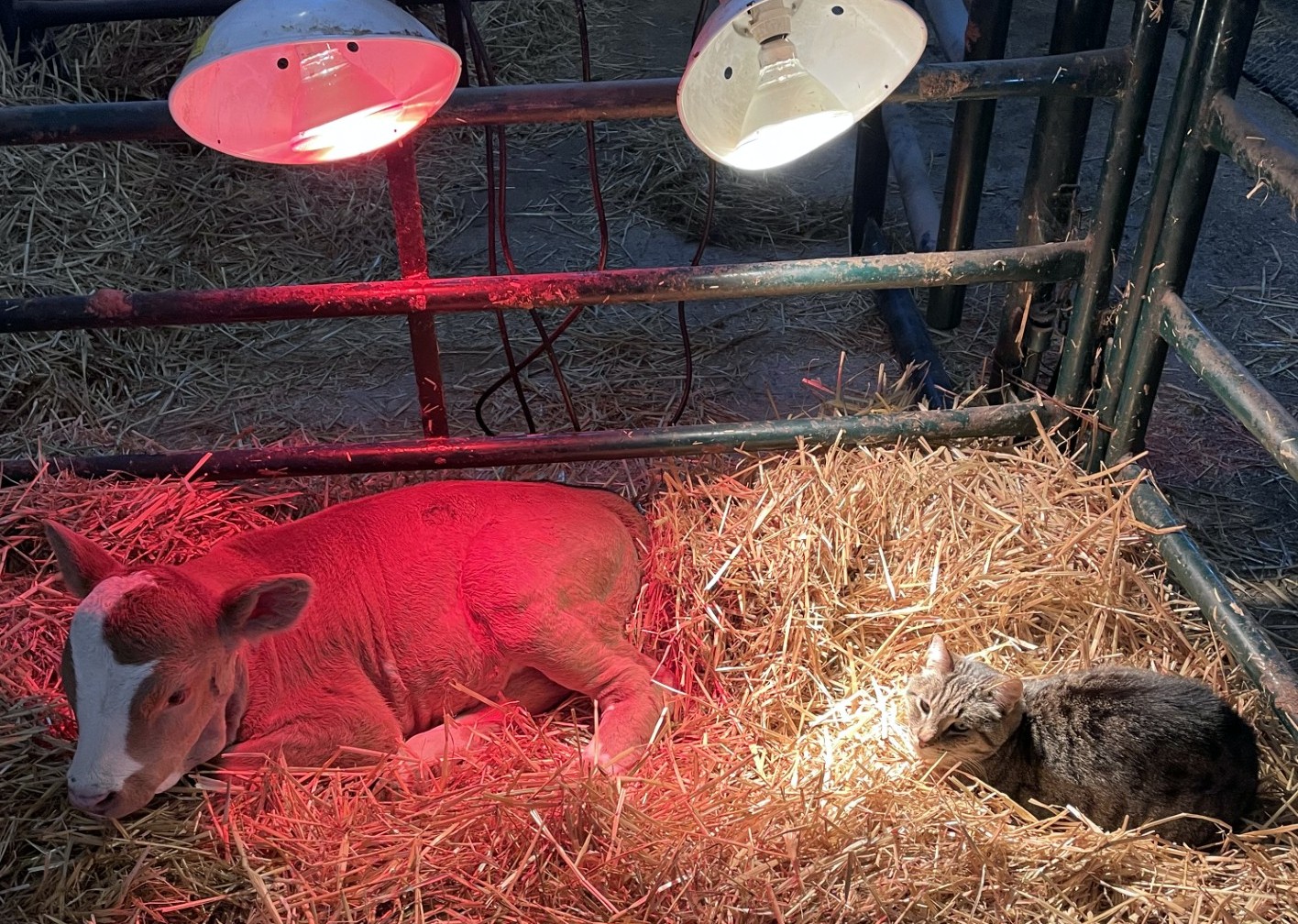
With little Prayer now drinking on her own, we were able to settle into more of a routine. We set up the rest of the barn , and gradually shifted from 3x a day nursing in the maternity pen, to finally having her do things on her own. In reality, Prayer figured things out very quickly, but those first few days were very intense and time consuming. In all, it took just over a week before she was able to nurse on her own in the ‘big pen’ of our calving barn – with only a bribe for mom, and the odd bit of assistance. Paprika never really warmed to the barn – and didn’t appreciate all the extra attention – although she still enjoyed the pellets, she just never seemed content…so after about a week in the barn, mom went outside for most of the day, while young Prayer stayed inside in the warmth.
When the next two calves arrived on Christmas day, we decided we might as well weigh all three. Prayer was 90lbs! So she certainly had progressed a long way – more than doubling her body weight in just over a month. With other calves around to socialize with, and us knowing that our peak calving window was right in front of us, we also started letting Prayer spend some time outside. Her hair had grown in, and while we were still concerned about an underdeveloped immune system, we knew that fresh air would be good for her. So she became used to leaving the barn in the morning, and then sneaking back inside at night time when the temperature dropped. Even in February, we would bring her back in the barn when nights dropped below -20. It was important for her to meet and bond with other calves, but we wanted to continue to give her, her best chance at success.

As winter turned to spring, and spring to summer, Prayer continued to progress. Despite her early birthdate, she was never one of the ‘big girls’, and we also suspect that her early arrival (and small tummy) impacted the amount of milk her dam produced. Come summer though, as the pictures will attest, she certainly stood with her group. She has grown A LOT of hair to make up for her early start, and continues to look like she has her genetic potential. She still has a few hurdles to pass – breeding in the spring – calving out in 2026 – but we remain cautiously optimistic. She even won the genetic lottery and tested homozygous polled. So certainly a great combination of determination, perseverance and luck! We look forward to continuing to work with her and hopefully those milestones will continue to be passed!


Ranching is not an easy occupation. We lose calves. Sometimes for reasons we aren’t sure of. An aborted calf can be simply another aborted calf. And then other times, we have our ‘Hope’ and we have our ‘Prayer’. Time that we invest. Willingly. As caretakers of our herd. It doesn’t always work out, but when it does we wanted to share the story. There can be so much negative in our chosen profession, and it is a profession that is often undertaken alone, so hopefully sharing our experience can help. Sometimes, Prayers are answered, and our efforts are rewarded, with a determined little girl that will always be our Prayer.
Until next time,
Dennis
Our Story of ‘Hope’


Our Story of ‘Hope’
At 4+ weeks premature, and weighing only 60% of a ‘normal’ birth weight, this is our story of an incredible little calf with an amazing will to live.
It was during a midnight cow check that a problem was spotted. A solitary foot was protruding from a heifer who, earlier that evening had been acting close, but was not due for a month. Just the single, small foot could mean trouble, so I went and woke Jeanne (standing instructions: no matter what the hour – if there is ever anything ‘interesting’ happening – get me up!) and we got the heifer into the barn to take a closer look. As anticipated, there was only one leg in the birth canal. With it being a smaller calf, we were able to push it back in slightly and get the other foot forward. There appeared to be plenty of room for the calf, so we let the heifer out of the head gate and let things finish normally.
The good news was that it was a live calf, and she appeared to be breathing on her own. The difficult part was that she was obviously premature and was very weak. Nowhere was this more pronounced than in her neck, which she didn’t have the strength to lift. Her attentive dam would lick her off, but her head just kept flopping around, providing no resistance to her mom’s attention. Hoping that time would provide some energy, we went back to the house for a couple of hours sleep.
With both of us working off the farm, morning chores start at 5:30am. With the calf being a ‘preemie’, both Jeanne and I went out to figure out how to ensure the calf had a good drink of colostrum. The calf was still very weak, and did not appear to be much stronger, but at least she did not appear to be any weaker. After assessing the situation, we quickly realized that the only way to get some milk in her was to strip it from her mom, and tube feed the calf. Fortunately for us, the dam was fairly quiet and we were able to get her in the head gate and milk her by hand. Tube feeding always provides mixed emotions. On one hand it is extremely important to get that colostrum into the calf so they can turn it into energy – it is always amazing how the calf perks up after that first drink – the flip side is having to stick a tube down a calf’s throat so that the fluid doesn’t go into their lungs. It certainly doesn’t look comfortable, and I am sure glad humans get IV’s! We also took the opportunity to complete our regular post calving rituals of weighing her and giving her a shot of Selenium / Vitamin E. Hopeful that the combination of milk, nutrients and vitamins would give her some more strength, we headed off to work.
Working in Red Deer, I was able to slip back home at lunch time for a few minutes to check on our new addition. It is a tougher task with one, but I was able to get more milk from the cow and give the calf another drink. The calf seemed stronger, with a little more control over her neck, but was still unable to stand. After a fair bit of research, and a chat with some seasoned cattlemen, I also gave her a shot of Dexemethezone to help her lungs. From everything I could read on the internet, the biggest survivability issue was with her lungs. Premature calves don’t yet have the lubrication in their lungs to allow them to breath correctly, so they often live for a bit and then fade away. The ‘Dex’ would hopefully give her lungs a little boost, and prevent them from drying out.
With both of us home after work, we put some teamwork into action. I managed to hold the calf up to the cow, while Jeanne positioned her head to the teats. The calf was weak, but wasn’t stupid. Once she got a teat in her mouth, she certainly knew how they worked. While it was certainly tiring (and occasionally frustrating) trying to get the calf to drink, it was great to see her accomplish this important milestone. A second feeding followed before bed, and we were certainly happy things appeared to be progressing.
Wednesday morning began about the same, but we hit another milestone over the noon hour. With a lot of assistance helping her to her feet, the calf would stand on her own. My evening check brought a few steps of walking to her repertoire, and an attentively licking mom helped to toughen her up and gain the balance skills she needed to stay standing on her feet. As a precautionary measure, we also gave her a shot of antibiotics – born prematurely with an immune system that wasn’t yet functioning, we hoped to ensure she had as good a chance as possible to get stronger.
I think it was Wednesday that we decided on the name ‘Hope’. We always prefer to call a calf by a name, and by this time, spending so much time with her, it just seemed like ‘Hope’ was the right fit. We were still in the early stages of her life, but it was so difficult not to have hope that she would make it. For so many of our frequent trips to the barn over the previous couple of days, we had just hoped that when, we opened the door, she would still be breathing. We were hoping that these gradual stages of improvement wouldn’t be undone by some internal challenges that we had no idea existed.
As Thursday dawned and we moved towards Friday, there was steady improvement. With Hope now being able to stand, and her mother having decided that we were only there to help, what was previously a two-person job was compressed into just one. I could get Hope standing near the right spot and Hope would brace herself against her mother’s back leg on her own, while I just had to worry about ensuring her head got in the correct position to get a drink. She became more confident and sure of herself until, on Friday evening, all I had to do was get her up, and she knew where to go and what to do. The best part was Saturday morning, when we went to the barn and found her drinking on her own.
Hope @ 6 days
Hope stayed in the barn for almost a month, to grow her limited hair coat out to a more normal length, before we let her outside to join the other calves. After spending so much time with her, it was truly special to see her out ‘bouncing around’ and playing with the other calves; just like normal. From what we can determine from our breeding chart, Hope was born 29 days early. The odds of her survival were extremely low, but with some hard work and some faith, she has made it through the toughest part. We are cautiously optimistic that she will continue to progress, and keep up with the other calves. It is just an incredible sight to see her standing out in the pasture with her very attentive mom – drinking away – her tail still going like it did in those first days – just another sign that makes makes us optimistic. It is hard not to become attached to a calf that took so much time and energy, so we remain ever Hope-ful that everything turns out alright.

Hope – June 20
 Applecross Cattle